Junction X OP Pohjola: QSVT4CRA — silver#
- Date:
2026-06-09
- Tags:
quantum, hackathon, junction, op-pohjola, var, qsvt, npe, factor-copula, sbi
- Original post:
My first time in the quantum world — and we took 2nd place on Junction X OP Pohjola’s challenge with QSVT4CRA: a Quantum Singular Value Transformation pipeline for Value-at-Risk estimation that fuses amortised Bayesian inference with a quantum block-encoding of the learned factor-copula.
This note preserves the LinkedIn write-up and adds a small amount of context. The team, in full: Milla Kolehmainen, Antti Nurminen, Silja Heiskanen — and huge credit to mentor Juha Vesanto.
The LinkedIn post#
I spent the weekend knee-deep in the quantum world, first time for me, and we won 2nd place on Junction X OP Pohjola’s challenge! It couldn’t have been possible without my team Milla Kolehmainen, Antti Nurminen, Silja H. and mentors such as the amazing Juha Vesanto.
We approached the challenge from a real problem: banks like OP run ~10k Monte Carlo simulations daily to estimate tail-risk, VaR and CVaR for different portfolios and assets. Current classical methods:
Scale poorly to higher dimensions
O(N·d·exp{c·d})Have slow error decay
O(sqrt{1/N}).While advanced classical methods such as HMC and SVI offer benefits over the traditional MC we wanted to research if going quantum-native could offer a speedup. We researched Quantum Singular Value Transformations and Quantum Amplitude Estimation for scalable VaR estimation for capital planning and stress testing. We found:
Standard QAE requires
kexpensive ancilla qubits forkassets.QSVT operates updates on single ancilla qubit but produces deeper circuits.
State loading eats up all of the quantum advantage if done poorly:
kassets get encoded to2^kamplitudes.Pre-calculated distributions (that would amortize state-prep) such as Gaussian Conditional Independence models scale poorly to Out-of-Distribution regimes (market shocks).
Our pipeline:
Train NPE over different regimes to output posterior samples for factor-copula given some data.
Block-encode factor-copula params (output of single forward pass on trained NPE) to QSVT unitary.
Compile circuit, and run QAE to output VaR+CVaR.
We were able to run our pipeline for a 12-asset portfolio on real IBM hardware (Boston) with ~10% error on VaR estimate. The error is due to decoherence and compounding gate error. Our work is fully open-source and documented in the project repo.
The Heron r3 scaling study#
The chart below is the headline result — a VaR-95 tail-estimate error sweep on IBM Heron r3 as the QSVT polynomial degree grows from 2 to 32, holding the shot budget fixed at 12 repetitions × 4096 shots per degree.
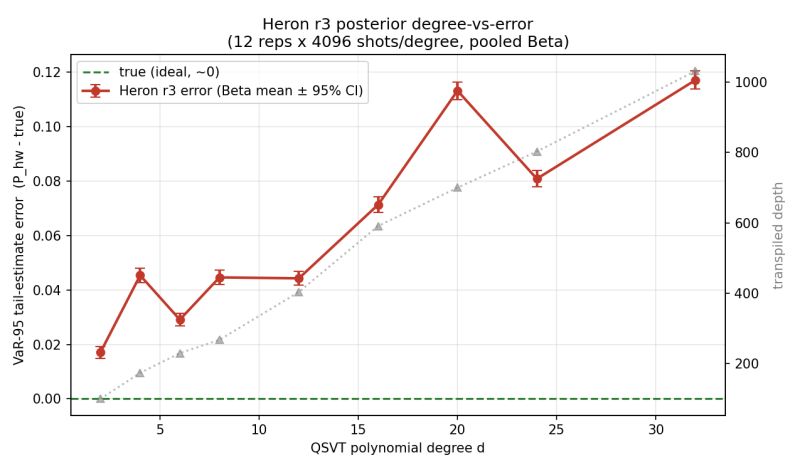
Heron r3 VaR-95 tail-estimate error vs QSVT polynomial degree. Error rises with degree and circuit depth, peaking around ~11% at degree 20; the green dashed line is the ideal target (zero error). The right axis shows the transpiled circuit depth growing roughly linearly in degree.#
Honest read: the pipeline runs end-to-end on a real superconducting QPU, but VaR-95 error scales with circuit depth in the regime we tested. Improving the depth-error tradeoff — better state-loading, shallower polynomials, or error mitigation — is the obvious next step.
What carried over from the rest of the work#
The factor-copula + amortised-Bayes framing is the same trick that anchors StimIQ and EASE Health: encode the structure you understand into a forward model, sample parameters from a posterior, and let the downstream algorithm consume those samples. Here the downstream algorithm is a QSVT unitary rather than a clinician-facing optimisation, but the epistemics are the same.
The formal companion to this work is the Lean 4 / Fable 5 proof that any copula vertex lifts to a quantum circuit in O(d²) two-qubit gates. Together, the empirical pipeline (this note) and the formal bound close the copula-to-quantum loop.
Links#
Repo: PlayerPlanet/QSVT4CRA
Original post: https://www.linkedin.com/feed/update/urn:li:activity:7470019622730248193/
Track: Junction X OP Pohjola