| INDEX |
|---|
| QShock |
| Results |
| Public. |
| Model |
| NEW: |
|---|
| Multiple shocks |
QShock — Project home page |
IntroductionShort description: QShock is a kinetic test-particle Monte Carlo code for particle transport in turbulent magnetised plasma flows, specialised in relativistic parallel shocks. It can/has been used to study, e.g., first- and second-order Fermi acceleration of electrons in parallel modified shocks and the effects of turbulence transmission to the acceleration efficiency. Origins: The numerical particle scattering and transport core of QShock was initially modified from a Monte Carlo simulation code developed in SRL (VISPA, University of Turku) by Leon Kocharov and Rami Vainio for interplanetary particle transport and coronal particle acceleration. Around this core, the QShock code was written by Joni Tammi (Virtanen back then) as a part of his M.Sc. and Ph.D. theses (2002-2006, Tuorla observatory, University of Turku). Present: The code package consists of the main Monte Carlo code and the basic data processing procedures, both written in Fortran 90/95, and some tools for more detailed processing and visualisation for IDL. Parallelisation is implemented using MPI. Full documentation is ''in preparation''. Future: The effects of the shock to the pre-existing turbulence is going to be implemented in the code (at the moment the turbulence conditions are calculated beforehands by an IDL program, and given as input parameters to the main code); possibilities for self-consistend turbulence generation by the particles themself is also in consideration. Furthermore, radiation production is going to be included in order to get the code to be more easily tested against real observable sources. |
Recent results
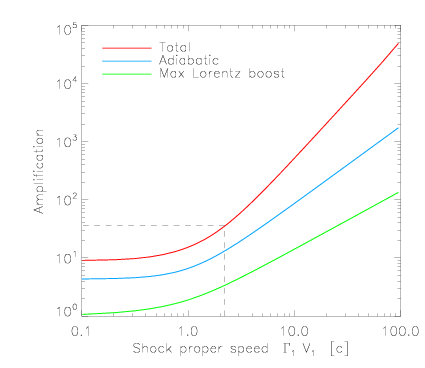
Particle acceleration by multiple parallel shocks
Particle acceleration
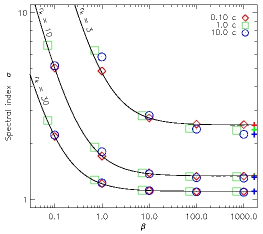
in thick parallel shock with large compression
Second order Fermi acceleration in parallel
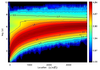
relativistic shocks
More results: click here, please. |
These web-pagesThese pages are maintained by Joni Tammi (Virtanen). The purpose for this site is to offer and store information and data related to QShock simulation and model. The location of the pages may change in future, but the redirection address www.iki.fi/joni.tammi/qshock should be stable. Copyright © 2004-2007 Joni Tammi.
|
| QUICK LINKS |
|---|
| ICRC 2007: Particle acceleration by multiple shocks (click) |
| Reseach Note: Thick shocks and high compression (A&A 439, 461) (click) |
| Figures for Virtanen & Vainio 2005, ApJ 621, 313 (click) |