| INDEX |
|---|
| QShock |
| Results |
| Public. |
| Model |
| SECTIONS |
|---|
| Introduction |
| Method |
| Results |
| Future work |
| References |
Particle acceleration by multiple parallel shocks |
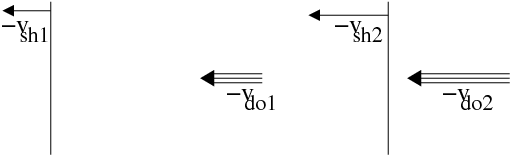
IntroductionThis study combines numerical simulations (QShock) by Joni Tammi (né Virtanen) and semi-analytical eigenfunction method (the "QJ method") developed by Kirk et al. (2000) and further extented by Paul Dempsey (2007). We have studied the first-order Fermi acceleration mechanism in parallel shocks by injecting particle spectra already accelerated at a shock into another shock. Preliminary results were presented at the "30th International Cosmic Ray Conference" in Mexico in July 2007, and a journal paper is in preparation. The study is not yet complete and the results presented here are still partial and somewhat preliminary. MethodWe first accelerated particles with initially low energy in a strong shock, and then injected the produced particle distribution into another shock "following" (and catching up) the first one. in this study we assumed the second shock to be a weak one, as in sources where multiple shocks are likely to occur, the pressure in the already-shocked upstream would probably not allow for strong subsequent shocks to be formed. This is probably the case in, e.g., kiloparsec-scale AGN jets or microquasar jets where separate knots have been seen to follow each others, and in the internal-shock scenario of gamma ray bursts. We used four different combinations for shock speeds and compressions. In each the first shock is a strong one and propagates into a cold plasma with speed Vsh1; compression of the first shock follows from the hydrodynamical jump conditions for a plasma satisfying the Jüttner-Synge equation of state. The second shock then follows this shock so that its speed in the laboratory frame, Vsh2, is higher than that of the first shock, i.e., it catches up the first shock. The compression ratio of the second shock is exactly 3 in all cases. The speeds can be seen in the Table 1, where also the downstream speeds, Vdo1 and Vdo2, are shown. These are the observed speed of the radiating plasma.
Results
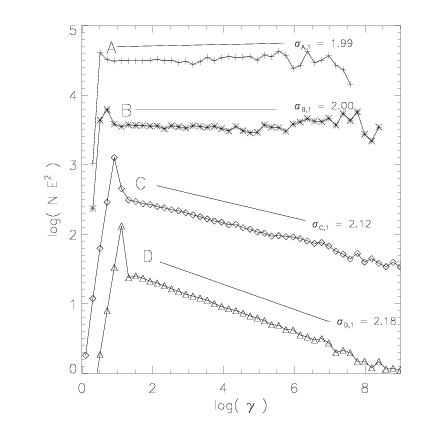
Figure 2. Simulated energy spectra (multiplied by E2) just downstream of the first shocks. Spectra have been shifted in that direction to allow for better comparison. Solid lines give slopes obtained from the eigenfunction method.
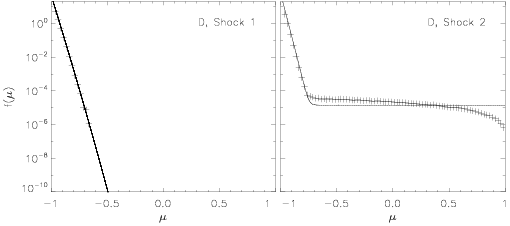
Figure 3. Distribution of power-law tail particles at both D-case shocks as measured in the upstream rest frames.
Energy spectra and pitch-angle distributions were
obtained for the first shocks using both the
eigenfunction method and particle simulations, and
there was good agreement between the two methods
in all aspects. Figure 2. shows
the energy spectra a few scattering lengths
downstream of the first shock in flow profiles A
and D (Table 1)
respectively. While the pitch-angle distribution
is isotropic at this distance downstream, it is
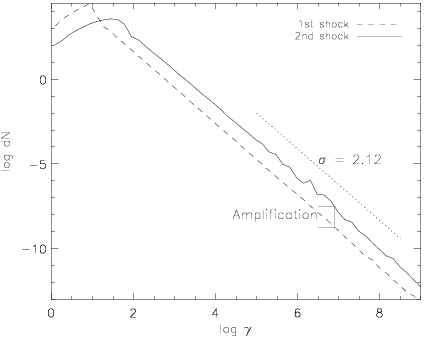
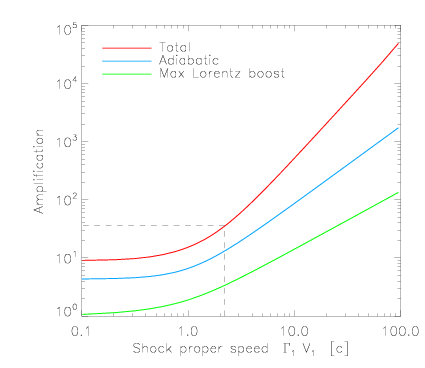
highly anisotropic at the shock front. Spectral index don't changeThe spectral index doesn't change at the second shock crossing due to the fact the the ''natural spectral index'' of such a weak shock is greater than the index for the injected spectra. Distribution is amplifiedAlthough the spectral slope of the distribution doesn't change at the crossing of a shock with speeper natural index, the energy distribution is affected otherwise. The whole power-law part is shifted due to Lorentz boost across the second shock, and also here part of the particle population is further accelerated by the first-order mechanism, leading to total amplification significantly higher than amplification only due to coordinate transformation across the shock. An example of this is shown in the C case in Figure 4, where the whole power-law is shifted vertically by the factor of 17.4. When considering the number density, the compression of the plasma adds further increase, leading to increase of total 230 in the f(p) distribution. In the following figure Fig. 5, these different contributions are plotted for various shocks speeds in the case of a shock with compression ratio of 3 and input spectrum having spectral index of 2.0. Green line marks the maximum gain from the Lorentz boost across the shock, blue shows the result of adiabatic gain due to compression, and red the total effect of the adiabatic gains and the first-order acceleration.
Anisotropy at the second shock
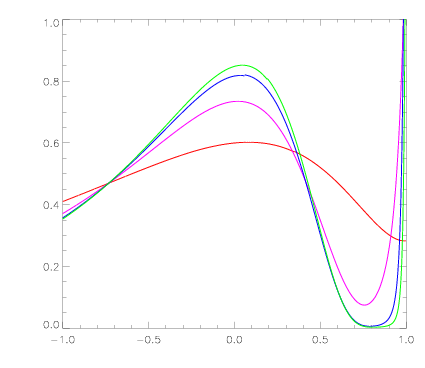
Figure 5. Pitch-angle distributions as measured at the second shock, as seen in the downstream rest frame of that shock. Red, lila, blue and green lines denote the cases A, B, C and D of Table 1, respectively. When one considers high-energy particles crossing the shock, the level of their anisotropy of course increases as the shock becomes relativistic. However, while for the second shock all the particles in the power-law tail are those that have re-crossed the schock from downstream to upstream and caught into the first-order acceleration process. However, when the high-energy spectrum –with a significant number of particles now in the power-law part– is injected into the second shock, most of the particles cross the shock only once as in the first shock, but now it's not only the returning particles that are counted, but also those that never return. As a result, when considering particles with the highest energies, there is now, in addition to the returners, a significant population of high-energy particles that cross the shock only once and end up in the downstream plasma with μ → +1.
In other words, unlike with the first shock,
immediately behind the second shock there
is a large number of very high particles with
pitch-angle poiting towards the downstream. As the
highest-energy particles can radiate their energy
away before they have had time to isotropise in
the local plasma frame, this effect could be
detectable in symmetrical sources having bipolar
jets. The possible effects are still being
studied.
Future and ongoing workThis study has been restricted to cases where the subsequent shock is always a weak one; a more general study is in progress at the moment, and it will extend the multiple shock study (for previous work, see, e.g., Melrose & Pope 1993; Pope & Melrose 1994) to fully relativistic regime. We have neglected the energy losses completely in this study, and the next natural step is to include losses due to syncrotron radiation and adiabatic expansion of the shocked plasma. Furthermore, inclusion of second-order Fermi acceleration (e.g., Virtanen & Vainio 2005) and other turbulence-based effects will be taken into account. The same applies to improved treatment of the plasma between the shocks, especially the escape and injection of particles. References
Copyright ©
Joni Tammi
Last modified 15 Aug 2007
|
||||||||||||||||||||||||||||||||||||||||