| INDEX |
|---|
| QShock |
| Results |
| Public. |
| Model |
| SECTIONS |
|---|
| Introduction |
| Background |
| Model & Theory |
| Simulations |
| Conclusions |
| References |
Particle acceleration in thick parallel shocks with large compression ratio |
IntroductionThis is a study done by Joni J.P. Virtanen (Tuorla Observatory) and Rami Vainio (University of Helsinki). The results and figures presented here have been published as a Research Note in Astronomy & Astrophysics journal (A&A 439, 461). See preprint astro-ph/0505598 or full article. We report studies on first-order Fermi acceleration in parallel modified shock waves with a large scattering center compression ratio expected from turbulence transmission models. Using a Monte Carlo technique we have modeled particle acceleration in shocks with a velocity ranging from nonrelativistic to ultrarelativistic and a thickness extending from nearly steplike to very wide structures exceeding the particle diffusion length by orders of magnitude. The nonrelativistic diffusion approximation is found to be surprisingly accurate in predicting the spectral index of a thick shock with large compression ratio even in the cases involving relativistic shock speeds. Background
First-order Fermi acceleration in shocks with
steplike velocity profile is well known to be an
efficient way of producing nonthermal particle
populations with power law distributions in
energy (see, e.g., reviews of Drury (1980) and
Kirk & Duffy (1999) for nonrelativistic and
relativistic studies, respectively). In the
nonrelativistic regime with infinitely thin
step-shocks this mechanism produces particle
momentum distributions
(1)
sKW = (3 V1 c2 - 2 V1
V22 + V23) /
(V1 - V2)c2 = (3r)/(r-1) * ( 1 - (V12 (2r-1))/(3c22r3) ) as was recently shown by Keshet & Waxman (2005).
In a modified shock -- i.e., in a shock with a
nontrivial velocity profile and finite shock
thickness -- the acceleration efficiency drops
as the thickness increases (e.g., Schneider
& Kirk 1989, Virtanen & Vainio
2003). Again, in the nonrelativistic case the
resulting spectral index as a function of shock
thickness and compression ratio can have a
simple analytical solution, found by Drury et
al.(1982), whereas the matter becomes much more
complicated in the relativistic regime (e.g.,
Schneider & Kirk 1989). In their
nonrelativistic study Drury et al. (1982) showed
that while the produced spectral index tends to
the well known step-shock limit when the shock
thickness approaches zero, the high energy part
of the spectrum can have a power law even when
the transition is large compared to free path of
an accelerating particle. The produced spectral
index depends on the thickness of the transition
region and the compression ratio as (2) where β is a parameter inversely proportional to the shock thickness. For a self-consistent cosmic-ray dominated shock it has the value of β = ½(1+γc), where γc is the adiabatic index of the cosmic-ray gas. Later Schneider & Kirk (1989) found the nonrelativistic diffusion approximation with spectral index of the form of Eq. (2) to agree well even in cases in which the thickness of the shock transition is of the order of the particle mean free path where the diffusion approximation should not be mathematically justified. In the relativistic regime the diffusion approximation was, expectedly, found to fail to approximate the produced spectral index.
From Eq.(2) it becomes obvious that even shocks
with large thickness (i.e., small β) can
accelerate particles efficiently if only the
compression ratio is sufficiently high. This may
seem irrelevant, as the gas compression ratio of
a shock is generally limited to rather small
values, e.g.,
Model and theory
As shown by Vainio & Schlickeiser (1998) for
nonrelativistic and Vainio et al. (2003,2005) for
relativistic speeds, shocks with low to moderate
quasi-Newtonian Alvénic Mach number
(3)
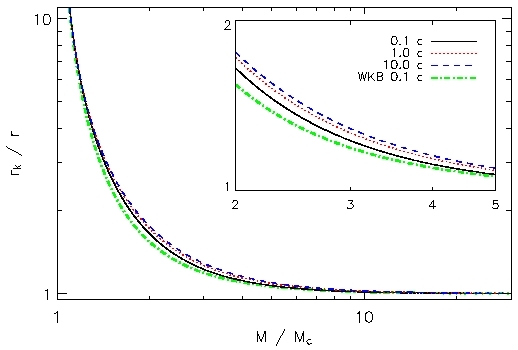
Figure 1. Ratio of the scattering center compression ratio rk to that of the gas r for different Alvénic Mach numbers M. The spectral index of the turbulence power spectrum is q=2, corresponding to a momentum- independent particle mean free path. See text for details. (Click for the figure in JPG and PS format.)
tends to infinity as the Alfvénic Mach
number of the shock
M = u1/uA1 (where
u1 and u_A1
are the shock proper speed and the upstream proper
Alfvén speed respectively, both measured in
the rest frame of the upstream plasma) approaches
the critical Mach number
The scattering hydromagnetic fluctuations have
wavelengths comparable to the Larmor radius of the
resonant particles. Thus, for shock waves
discussed in this paper, the Alfvén waves
actually see the shock front as a thick
structure. Thus, their transmission becomes
governed by the WKB theory. A detailed analysis of
this case is beyond the scope of this short Note
but qualitatively one expects wave transmission in
these shocks to show very similar behavior as in
steplike shock waves: antiparallel propagating
waves are amplified much more than the parallel
propagating ones because of the conservation of
the wave action,
(4)
for the downstream intensities of waves propagating parallel (antiparallel) to the flow, (4)
Thus, Simulations
We have used test-particle Monte Carlo simulations to calculate the
particle energy spectral indices σ=s-2
resulting from first-order Fermi acceleration at the
shock for parallel shocks. Detailed description of the code is given
elsewhere (Appendix A of Virtanen & Vainio 2005). The
simulations follow test-particles in a one dimensional flow. Small
pitch angle scatterings are performed in the frame comoving with the
scattering centers. Instead of using two scattering wave fields,
(5)
Here, λ is the (constant) particle mean free path and the parameter β the same as in Eq. (2). In this study we consider β as a free parameter and simulate shocks of different widths by varying its value. Defining the diffusion length of the particles in the usual nonrelativistic manner as di = (1/3)λc/Vi, we can write the inverse shock thickness as
For each simulation we fix the proper speed of the shock relative to
the upstream scattering centers,
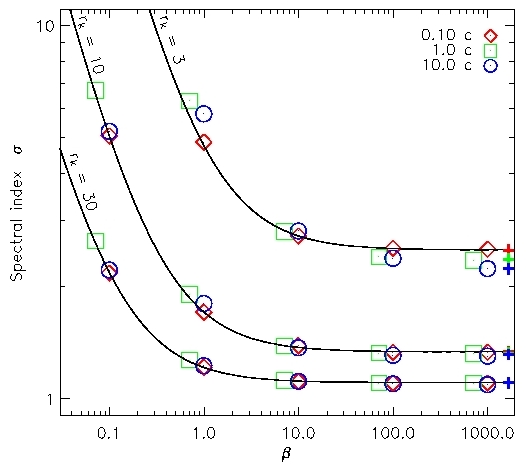
Figure 2.
Spectral indices as a function of β for shock proper
speeds u1 = 0.1 c (diamonds), 1.0 c (squares), and
10.0 c (circles) for scattering center compression ratios
rk = 3, 10, and 30, drawn in red, blue and green
respectively; the crosses at the right end denote the values
obtained from Eq. (1) for step-shocks
(
Simulations were run for shock proper speeds
In the nonrelativistic case (u1 = 0.1 c) the results are as expected: spectral indices are in accordance with the diffusion approximation in all cases, even where the shock thickness is comparable to the diffusion length of the particles. This is the case with allcompression ratios studied.
For the mildly relativistic case
(u1 = 1.0 c) and the lowest compression ratio
rk=3
(corresponding to the gas compression ratio of a relativistic
parallel shock) the simulated indices start to differ from the
diffusion approximation, and the differences grow even larger for the
ultrarelativistic case (u1 = 10.0 c).
At the step-shock limit, where
The most unexpected result of our study is, however, that as the compression ratio increases above the traditional gas-compression ratio values, the nonrelativistic diffusion approximation works rather well even for relativistic shocks. Small deviations are seen in all cases where relativistic effects are present, but the spectral indices can be approximated by Eq. (1) to an accuracy of the relevant observations, especially for the case rk=30. Furthermore, even shocks with very wide transition can produce spectra that are hard, compared to those usually considered to be produced in parallel shocks. ConclusionsBased on our analysis, we arrive at the following conclusions of particle acceleration at modified shocks.
References
Copyright ©
Joni Virtanen
Last modified 3 Jun 2005
|