About
TensorFlowSNA is a research project mining the TensorFlow software ecosystem with Social Network Analysis

Motivation
- Many firms develop open-source platforms. But why and how big-tech giants like Google open-sourced advanced and complex technological platforms that started in-house? In other words, why releasing a complex and advanced technology with a open-source license and work with the community after so many internal investments?
- Many rival firms simultaneously collaborate and compete in the open-source arena, i.e. open-coopetition (Teixeira, J. A. 2023). Why and how do rival technology vendors joint-develop the TensorFlow machine learning platform?
Key references
Key theoretical references
- Teixeira, J. A. (2023). Towards understanding open-coopetition -- Lessons from the automotive industry. in Proceedings of the 44th International Conference on Information Systems (ICIS 2023) AIS. Open-access right here.
- Teixeira, J. A., Ahmed, S. S., Laine-Kronberg, L., Mezei, J., & Smailhodzic, E. (2025). Towards understanding open and coopetitive platform ecosystems: The case of TensorFlow. in Proceedings of the 33th European Conference on Information Systems (ECIS 2025) AIS. Open-access right here.
- Jacobides, M. G., Cennamo, C., & Gawer, A. (2018). Towards a theory of ecosystems. Strategic Management Journal, 39(8), 2255-2276. Open-access at https://onlinelibrary.wiley.com/doi/full/10.1002/smj.2904.
Key methodological references
- Teixeira, J., Robles, G., & González-Barahona, J. M. (2015). Lessons learned from applying social network analysis on an industrial Free/Libre/Open Source Software ecosystem. Journal of Internet Services and Applications, 6, 1-27. Open-access at https://link.springer.com/article/10.1186/s13174-015-0028-2.
- Teixeira, J., Mian, S., & Hytti, U. (2016). Cooperation Among Competitors in the Open-Source Arena: The Case of Openstack. In Proceedings of the 37th International Conference on Information Systems (ICIS 2016) AIS. Open-access at https://arxiv.org/abs/1612.09462 .
- Herbold, S., Amirfallah, A., Trautsch, F., & Grabowski, J. (2021). A systematic mapping study of developer social network research. Journal of Systems and Software, 171, 110802. Closed-access at https://www.sciencedirect.com/science/article/pii/S0164121220302077 .
- Zhu, J., & Wei, J. (2019, May). An empirical study of multiple names and email addresses in oss version control repositories. In 2019 IEEE/ACM 16th International Conference on Mining Software Repositories (MSR) (pp. 409-420). IEEE. Closed-access at https://ieeexplore.ieee.org/abstract/document/8816766.
Related working papers from others
- Osborne, C., Daneshyan, F., He, R., Ye, H., Zhang, Y., & Zhou, M. (2025). Characterising open source co-opetition in company-hosted open source software projects: the cases of PyTorch, TensorFlow, and transformers. Proceedings of the ACM on Human-Computer Interaction, 9(2), 1-30. Open-access at https://doi.org/10.1145/3710944.
Aim, objectives and research questions
Overall aim:
- Advance our understanding on open-source, and open-coopetition by looking at the case of TensorFLow;
Objectives:
Primary objectives:
- Contribute to open-source motivations literature;
- Contribute to open-coopetition literature;
- Document the history of TensorFLow;
- Advance the mining of software repositories with Social Network Analysis;
Secondary objectives:
- Contribute to platform ecosystems literature;
- Contribute to coopetition literature;
- Contribute to open-innovation literature;
- Contribute to triple helix innovation literature;
- Improve existing open-source tools that mine software repositories;
Research questions:
Regarding tech giants
- Why do tech giants like Google open-source advanced and complex technological platforms that started in-house?
- Why are different organizations cooperating with competitors in the co-production of advanced technological platforms?
Regarding non-commercial organizations
- How did non-commercial entities contribute to the development of the TensorFlow open and coopetitive platform for AI and ML?
- How do the different freedoms of open and coopetitive platforms align with the different interests of commercial, non-commercial and governmental organizations?
Research team
By chronological order as contributors worked on the project:
- José A. Apolinário Teixeira @ Aalto University, Espoo, Finland
- Syed Sabbir Ahmed @ University of Jyväskylä, Jyväskylä, Finland
- Edin Smailhodzic @ University of Groningen, Groningen, Netherlands
- Annika Laine-Kronberg @ Åbo Akademi University, Åbo, Finland
- József Mezei @ Information Systems @ Åbo Akademi University, Turku, Finland
- Ivan Belik @ NHH Norwegian School of Economics, Norway
Methodological overview
Mix-methods approach
We combined and virtual-ethnography (VE) with a Social Network Analysis (SNA) over publicly-available and naturally-occurring open-source data that allowed us to re-construct and visualize the evolution of the TensorFlow collaboration as a sequence of networks. Knowledge from the VE informed the SNA and the other way around as we attempted not only to retrieve collaborative networks but also to interpret and explain them. We will also engage with active developers and a community manager to validate our preliminary results and findings.
Virtual Ethnography
We started by screening, by virtual ethnographic manners, publicly available data such as company announcements, financial reports and specialized-press that allowed us to gain insights of the industrial context. Then we could better design the mining of software repositories with SNA.
Social Network Analysis
After attaining a better understanding of the competitive dynamics of the Cloud Computing Industry, we started extracting and analysing the social network of the OpenStack community leveraging SNA (Scott, 2012; Wasserman and Faust, 1994), which is an emergent method widely established across disciplines of social sciences in general (Borgatti and Foster, 2003; Uzzi, 1996; Wasserman and Faust, 1994; Watts, 2004)
For understanding the evolution of the code-based collaboration, we connect developers who work on the same file, constructing a network of collaboration activities among developers. With the visualization of the network over time, we gain insights on collaboration and rivalry within the software project.

Semi-Structured interviews
Targeting software developers (i.e., code contributors to TensorFlow core) and program managers at the top 10 firms.Guiding questionnaire for max 40 min interview:
- I assume from the data I have collected so far, that you are a contributor TensorFlow? Is that correct?
- What kind of contributions have you added to TensorFlow? Can you give examples?
- What motivated you to contribute?
- Are you the only one contributing to TensorFlow at your organization, or do you have a team that contributes regularly to TensorFlow?
- Will your contributions contribute to your career advancement?
- Would it be possible to file a patent related to your contribution?
- Are you worried that others might make money with your contribution?
- Do you perceive some inter-individual or inter-organizational competition in TensorFlow or is it all about collaboration?
- Do you consider contributing more to TensorFlow in the future? What about other projects?
- Do you think that governments should encourage contributions to open-source communities from universities? What about commercial companies?
- What are the main barriers that an AI or ML researcher faces when contributing to an open-source project?
- In what way do AI and ML researchers depend on the for-profit industry?
Real time transcription using Wisper
Tools
Tools for mining git repositories with SNA
- ScrapLogGit2Net by José A. Teixeira.
- git2net by Christoph Gote.
Tools for the visualization of social networks
- visone is a software for the visual creation, transformation, exploration, analysis and representation of network data, jointly developed at the University of Konstanz and the Karlsruhe Institute of Technology.
- Tulip is an information visualization framework dedicated to the analysis and visualization of relational data. Tulip aims to provide the developer with a complete library, supporting the design of interactive information visualization applications for relational data that can be tailored to the problems he or she is addressing. Developed by LaBRI, University of Bordeaux, France.
Tools for the statistical analysis of social networks
- statnet is a suite of open source R-based software packages for network analysis, along with a comprehensive set of training materials. Developed by Pavel Krivitsky, Skye Bender-deMoll, Michał Bojanowski, Carter T. Butts, Steven M. Goodreau, Mark S. Handcock, David R. Hunter, Chad Klumb, and Martina Morris among others.
- Goldfish is a software tool (i.e. R package) for the analysis of time-stamped network data using a variety of models. In particular, it implements different types of Dynamic Network Actor Models (DyNAMs), a class of models that is tailored to the study of actor-oriented network processess through time. Goldfish also implements different versions of tie-oriented relational event models. Developed by members of the Chair of Social Networks at ETH Zürich and James Hollway at the Graduate Institute in Geneva.
Results
TOP 10 organizational contributors that cooperate with others in the co-production of TensorFlow
First in terms of number of nodes/developers, then in terms of Lines of Code * Number of Commits:
- Google (cloud services, software tools, training and consulting) - 970 developers to TensorFlow core
- Intel (chipsets) - 93 developers to TensorFlow core
- Nvidia (chipsets) - 61 developers to TensorFlow core
- ARM (chipsets) - 48 developers to TensorFlow core
- IBM (cloud services, software tools, training and consulting)- 41 developers to TensorFlow core
- AMD (chipsets) - 27 developers to TensorFlow core
- Microsoft (cloud services, hardware, software tools, training and consulting) - 16 developers to TensorFlow core
- Huwaei (cloud services, hardware, software tools) - 12 developers to TensorFlow core
- Amazon (cloud services, software tools, training and consulting) - 11 developers to TensorFlow core
- Naver (cloud services, software tools) - 11 developers to TensorFlow core
TOP 10 non-commercial contributors that cooperated with others in the co-production of TensorFlow
First in terms of number of nodes/developers, then in terms of Lines of Code * Number of Commits:
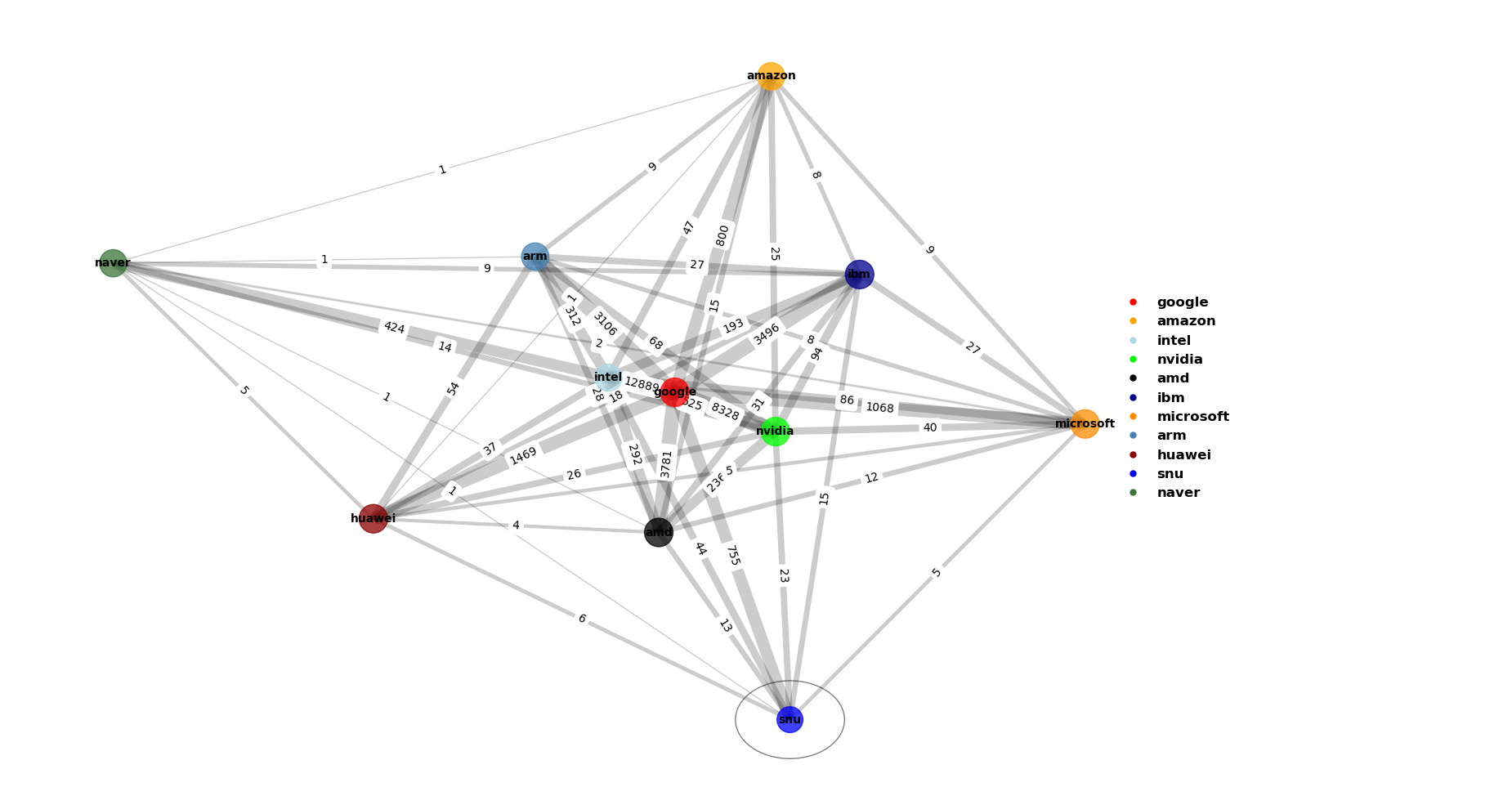
- Seoul National University - SNU (Korean: 서울대학교)
- German Research Center for Artificial Intelligence (German: Deutsches Forschungszentrum für Künstliche Intelligenz - DFKI)
- Chromium - a free and open-source web browser project
- Institute for System Programming - ISP of the Russian Academy of Sciences (Russian: Институт системного программирования)
- Peking University - PKU (Simplified Chinese :北京大学)
- Georgia Institute of Technology - GeorgiaTech
- Massachusetts Institute of Technology - MIT
- Apache Software Foundation - an American nonprofit corporation to support a number of open-source software projects
- Royal Institute of Technology (Swedish: Kungliga Tekniska högskolan - KTH)
- University of California, Berkeley
Social network visualizations - Both inter-individual and inter-organizational collaborative networks
Inter-individual collaborative networks
The overall history of TensorFlow (7 Nov 2013 - 12 April 2024)
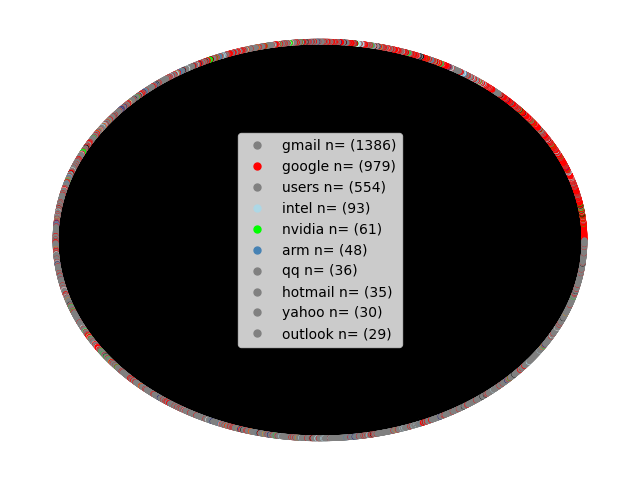
Circa 9 years of code-collaboration (7 Nov 2013 - 12 April 2024).
Circular layout. Nodes coloured by organizational affiliation.
Bots were filtered but developers names were not consolidated yet.
See that 554 developers are incorrectly affiliated with users!
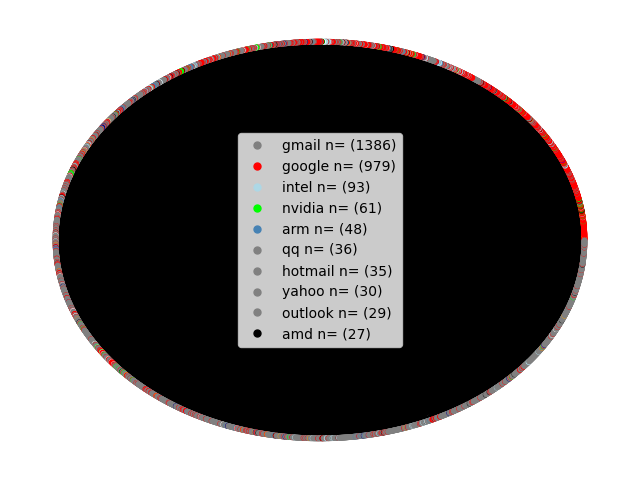
Circa 9 years of code-collaboration (7 Nov 2013 - 12 April 2024).
Circular layout. Nodes coloured by organizational affiliation.
Bots were filtered and developers names were consolidated yet.
See Setting your commit email address documentation from GitHub Docs for an explanation on why so many commits were associated with USERNAME@users.noreply.github.com.
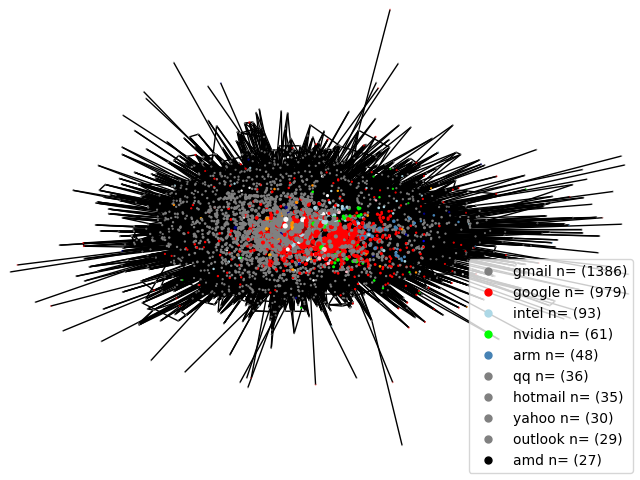
Circa 9 years of code-collaboration (7 Nov 2013 - 12 April 2024).
Centrality layout. Nodes coloured by organizational affiliation and sized by centrality.
Nodes position by Fruchterman-Reingold force-directed algorithm.
Bots were filtered and developers names were consolidated.
All dev. affiliated with all organizations.
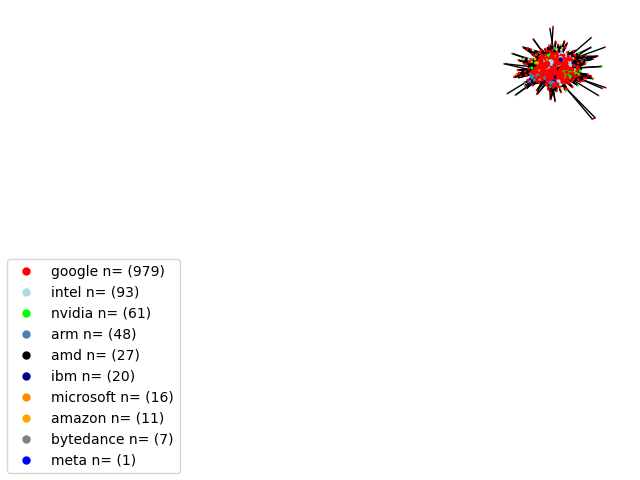
Circa 9 years of code-collaboration (7 Nov 2013 - 12 April 2024).
Centrality layout. Nodes coloured by organizational affiliation and sized by centrality.
Nodes position by Fruchterman-Reingold force-directed algorithm.
Bots were filtered and developers names were consolidated.
Limited to the top 10 contributors that compete with others in the co-production of TensorFLow.
All dev. affiliated with ['google','microsoft','ibm','amazon','intel','amd','nvidia','arm','meta','bytedance'].
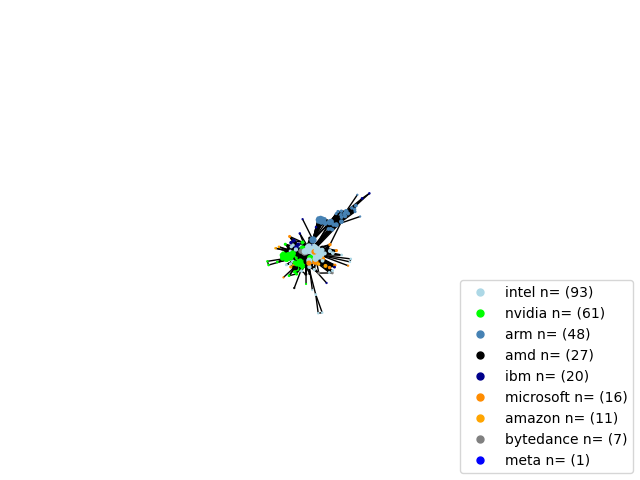
Circa 9 years of code-collaboration (7 Nov 2013 - 12 April 2024).
Centrality layout. Nodes coloured by organizational affiliation and sized by centrality.
Nodes position by Fruchterman-Reingold force-directed algorithm.
Bots were filtered and developers names were consolidated.
Limited to the top 10 contributors that compete with others in the co-production of TensorFLow excluding Google.
All dev. affiliated with ['microsoft','ibm','amazon','intel','amd','nvidia','arm','meta','bytedance'].
Last months of 2015
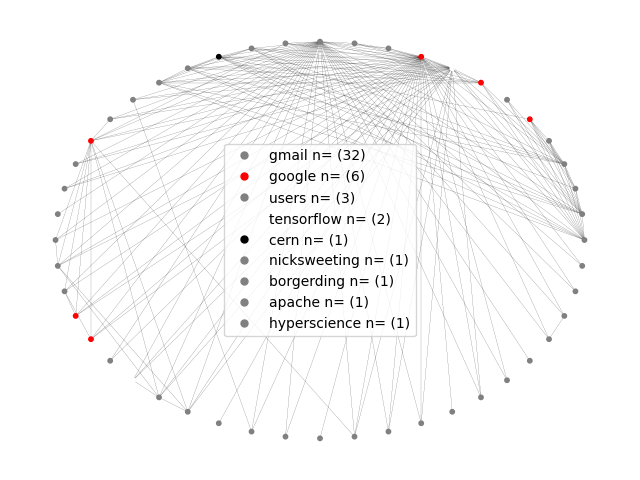
Circular layout. Nodes coloured by organizational affiliation.
Bots were filtered but developers names were not consolidated yet.
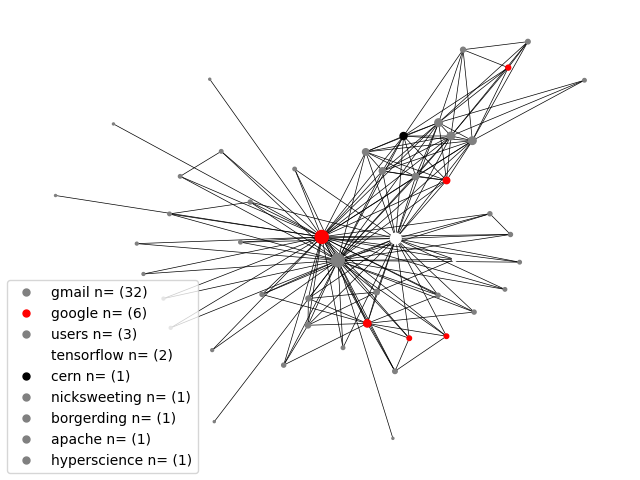
Centrality layout. Nodes coloured by organizational affiliation and sized by centrality.
Nodes position by Fruchterman-Reingold force-directed algorithm.
Bots were filtered but developers names were not consolidated yet.
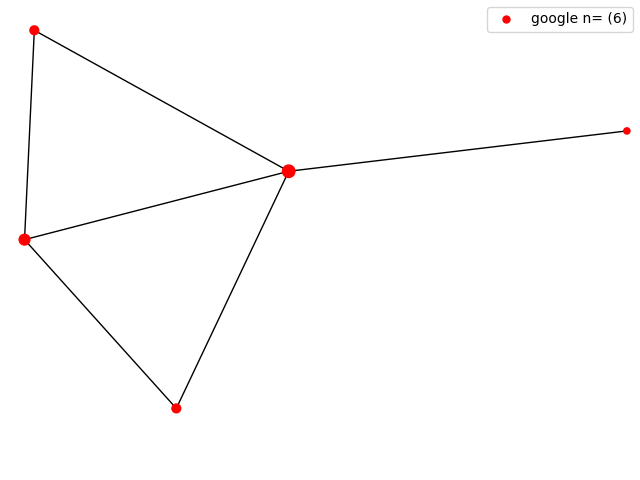
First commit Sat Nov 7 by Vijay Vasudevan (vrv AT google.com) starts TensorFlow as an open-source project.
Centrality layout. Nodes coloured by organizational affiliation and sized by centrality.
Nodes position by Fruchterman-Reingold force-directed algorithm.
Bots were filtered and developers names were consolidated.
Limited to the top 10 contributors that compete with others in the co-production of TensorFLow.
All dev. affiliated with ['google','microsoft','ibm','amazon','intel','amd','nvidia','arm','meta','bytedance'].
2016
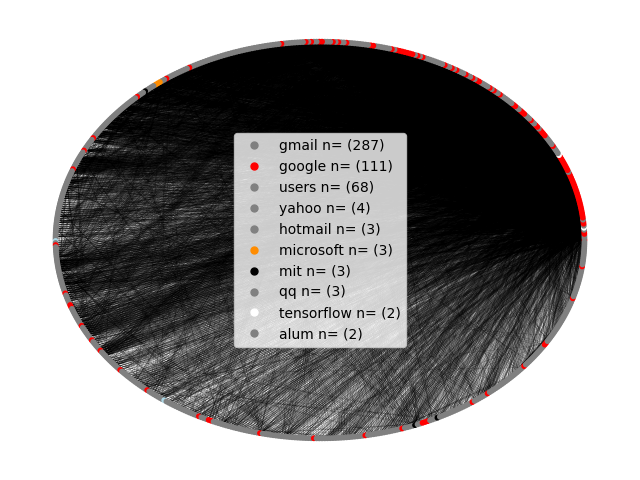
Circular layout. Nodes coloured by organizational affiliation.
Bots were filtered but developers names were not consolidated yet.
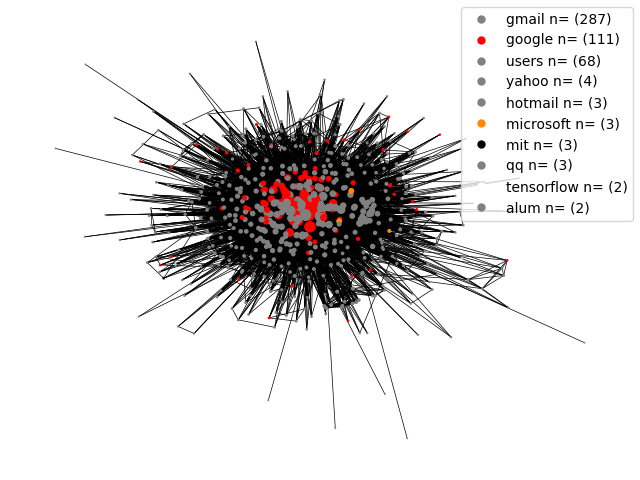
Centrality layout. Nodes coloured by organizational affiliation and sized by centrality.
Nodes position by Fruchterman-Reingold force-directed algorithm.
Bots were filtered but developers names were not consolidated yet.
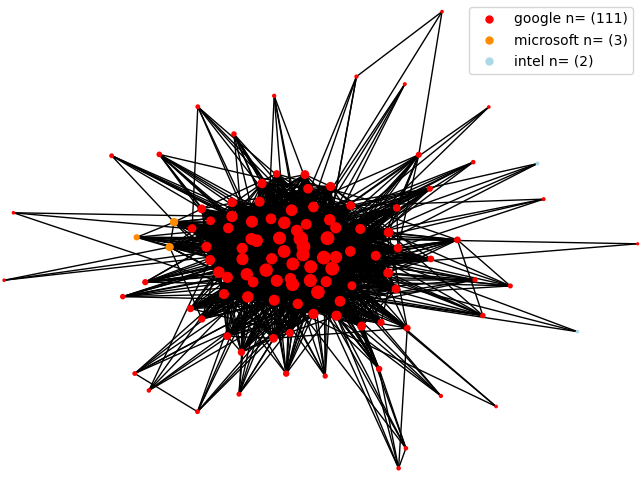
Centrality layout. Nodes coloured by organizational affiliation and sized by centrality.
Nodes position by Fruchterman-Reingold force-directed algorithm.
Bots were filtered and developers names were consolidated.
Limited to the top 10 contributors that compete with others in the co-production of TensorFLow.
All dev. affiliated with ['google','microsoft','ibm','amazon','intel','amd','nvidia','arm','meta','bytedance'].
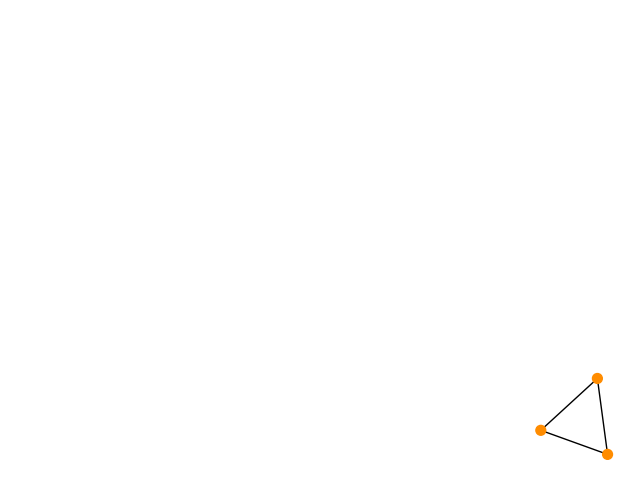
Centrality layout. Nodes coloured by organizational affiliation and sized by centrality.
Nodes position by Fruchterman-Reingold force-directed algorithm.
Bots were filtered and developers names were consolidated.
Limited to the top 10 contributors that compete with others in the co-production of TensorFLow excluding Google.
All dev. affiliated with ['microsoft','ibm','amazon','intel','amd','nvidia','arm','meta','bytedance'].
2017
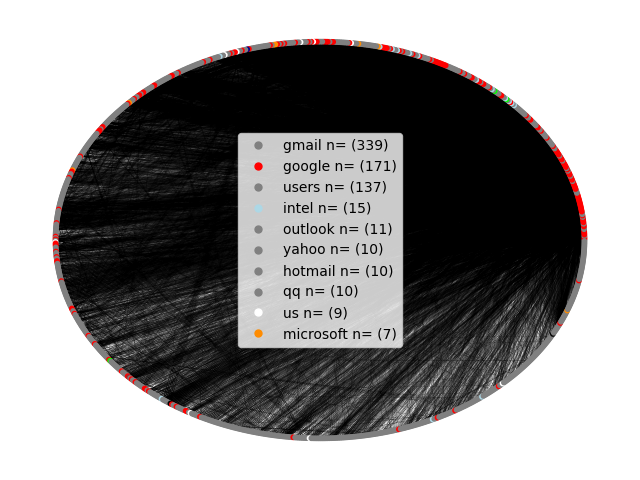
Circular layout. Nodes coloured by organizational affiliation.
Bots were filtered but developers names were not consolidated yet.
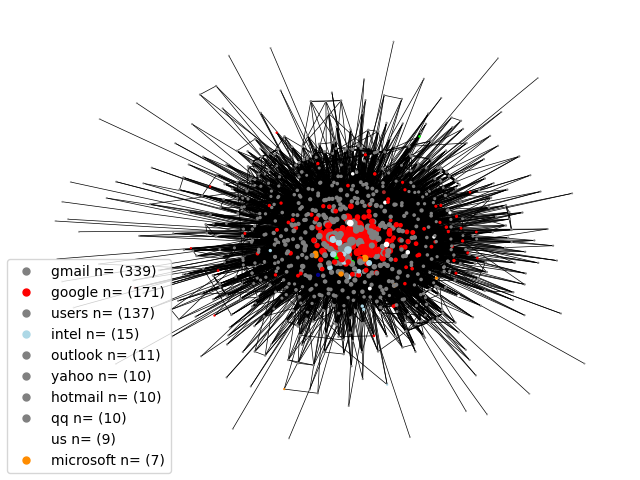
Centrality layout. Nodes coloured by organizational affiliation and sized by centrality.
Nodes position by Fruchterman-Reingold force-directed algorithm.
Bots were filtered but developers names were not consolidated yet.
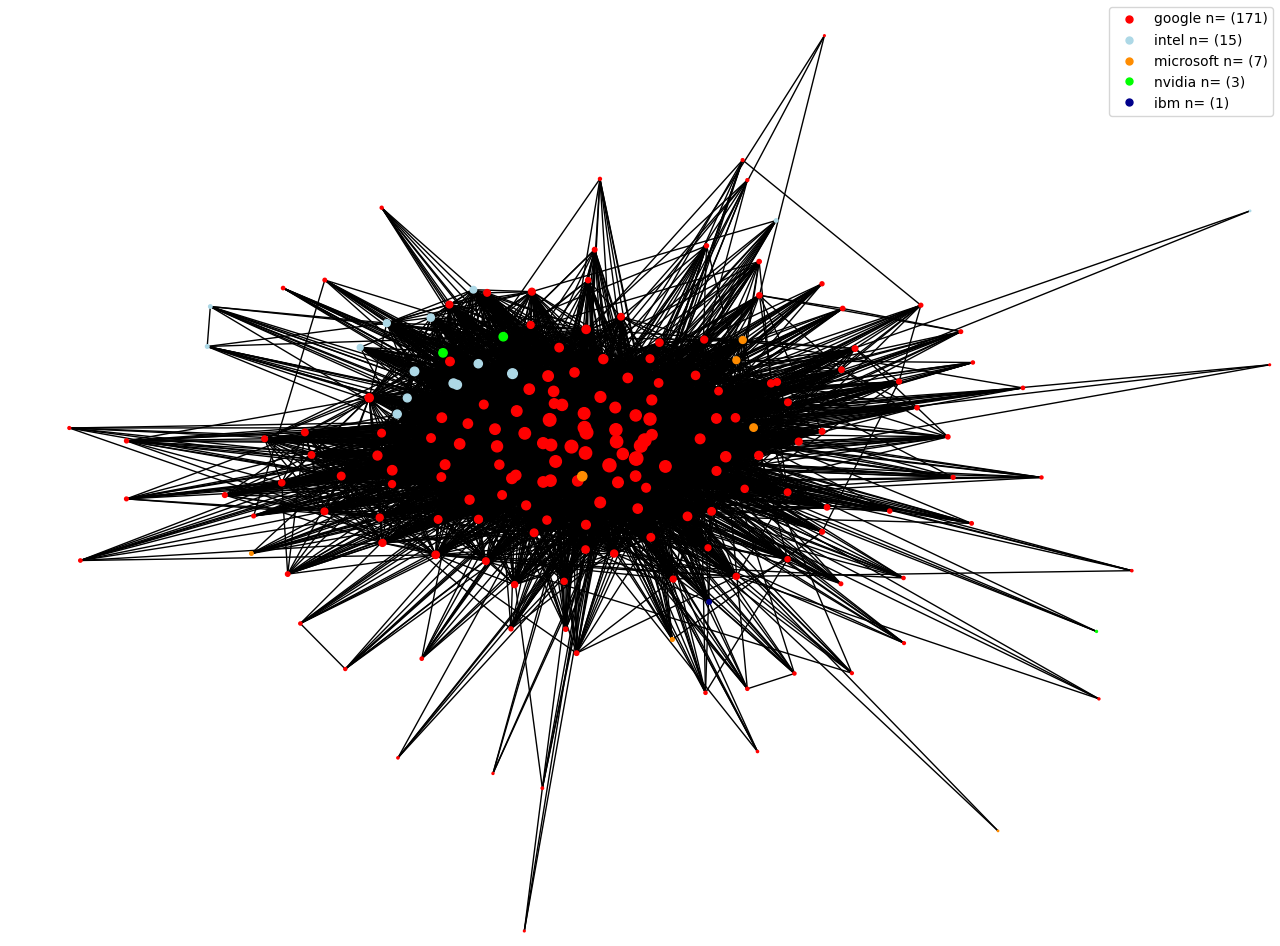
Centrality layout. Nodes coloured by organizational affiliation and sized by centrality.
Nodes position by Fruchterman-Reingold force-directed algorithm.
Bots were filtered and developers names were consolidated.
Limited to the top 10 contributors that compete with others in the co-production of TensorFLow.
All dev. affiliated with ['google','microsoft','ibm','amazon','intel','amd','nvidia','arm','meta','bytedance'].
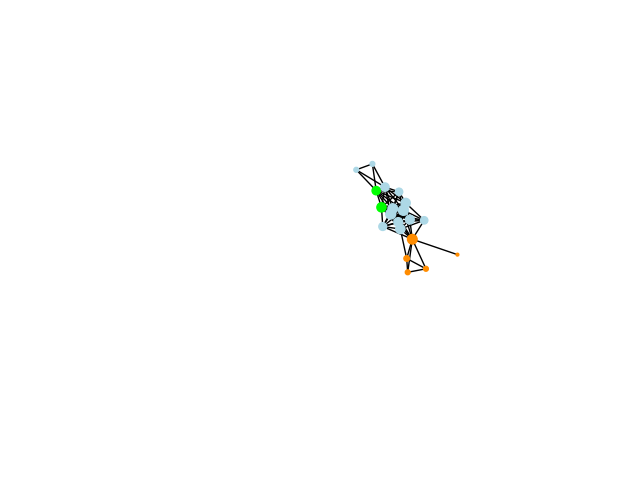
Centrality layout. Nodes coloured by organizational affiliation and sized by centrality.
Nodes position by Fruchterman-Reingold force-directed algorithm.
Bots were filtered and developers names were consolidated.
Limited to the top 10 contributors that compete with others in the co-production of TensorFLow excluding Google.
All dev. affiliated with ['microsoft','ibm','amazon','intel','amd','nvidia','arm','meta','bytedance'].
2018
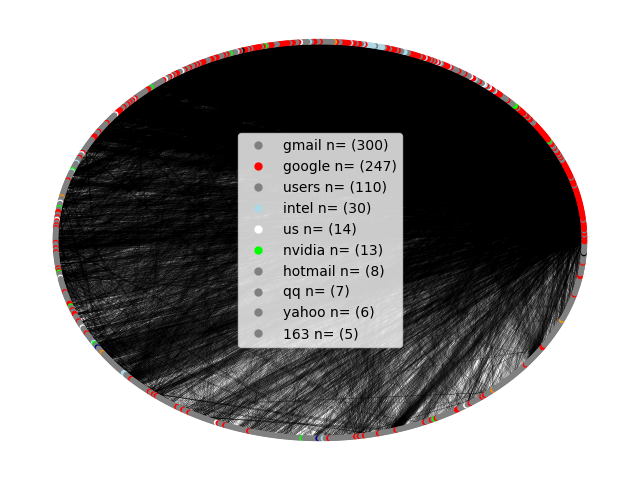
Circular layout. Nodes coloured by organizational affiliation.
Bots were filtered but developers names were not consolidated yet.
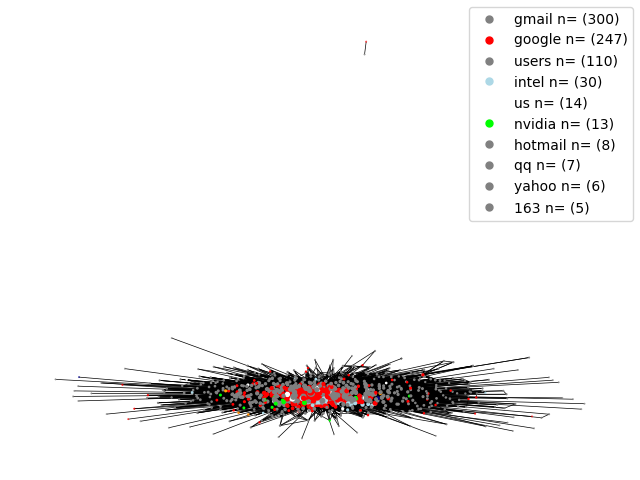
Centrality layout. Nodes coloured by organizational affiliation and sized by centrality.
Nodes position by Fruchterman-Reingold force-directed algorithm.
Bots were filtered but developers names were not consolidated yet.
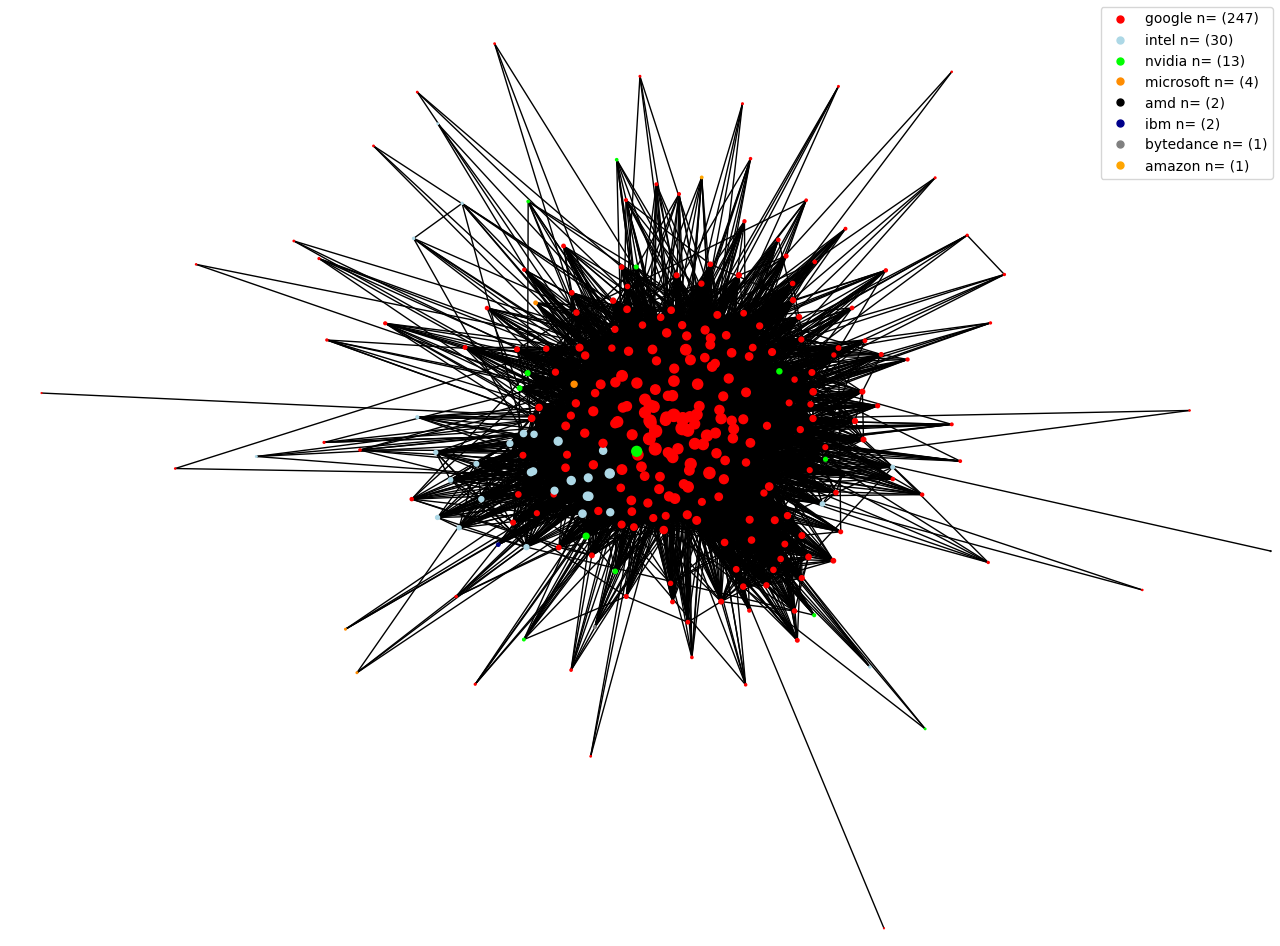
Centrality layout. Nodes coloured by organizational affiliation and sized by centrality.
Nodes position by Fruchterman-Reingold force-directed algorithm.
Bots were filtered and developers names were consolidated.
Limited to the top 10 contributors that compete with others in the co-production of TensorFLow.
All dev. affiliated with ['google','microsoft','ibm','amazon','intel','amd','nvidia','arm','meta','bytedance'].
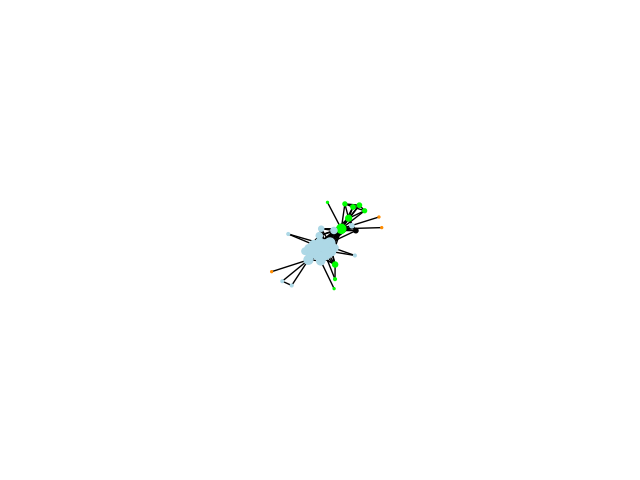
Centrality layout. Nodes coloured by organizational affiliation and sized by centrality.
Nodes position by Fruchterman-Reingold force-directed algorithm.
Bots were filtered and developers names were consolidated.
Limited to the top 10 contributors that compete with others in the co-production of TensorFLow excluding Google.
All dev. affiliated with ['microsoft','ibm','amazon','intel','amd','nvidia','arm','meta','bytedance'].
2019
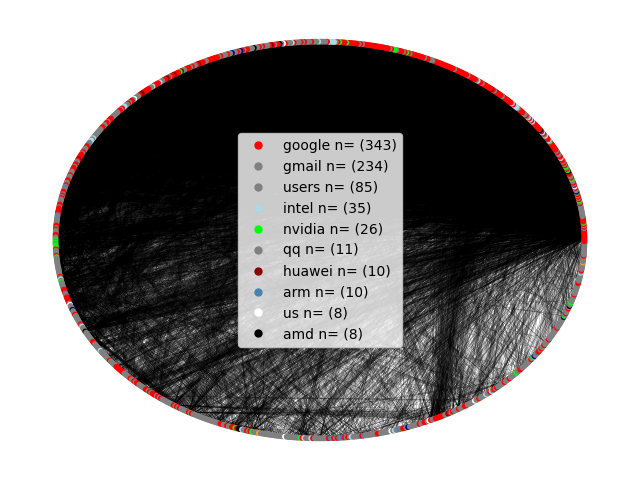
Circular layout. Nodes coloured by organizational affiliation.
Bots were filtered but developers names were not consolidated yet.
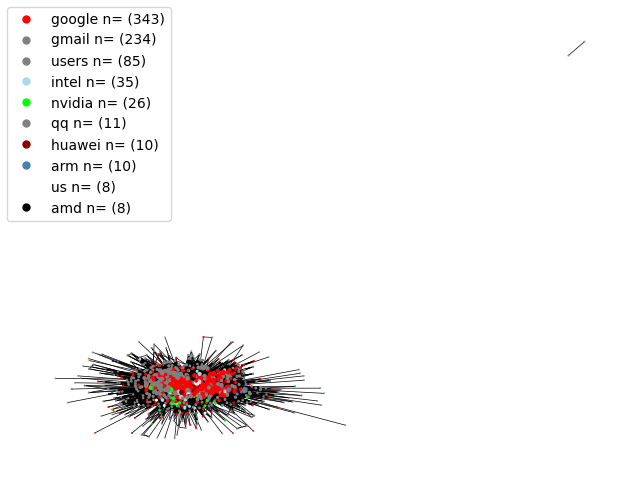
Centrality layout. Nodes coloured by organizational affiliation and sized by centrality.
Nodes position by Fruchterman-Reingold force-directed algorithm.
Bots were filtered but developers names were not consolidated yet.
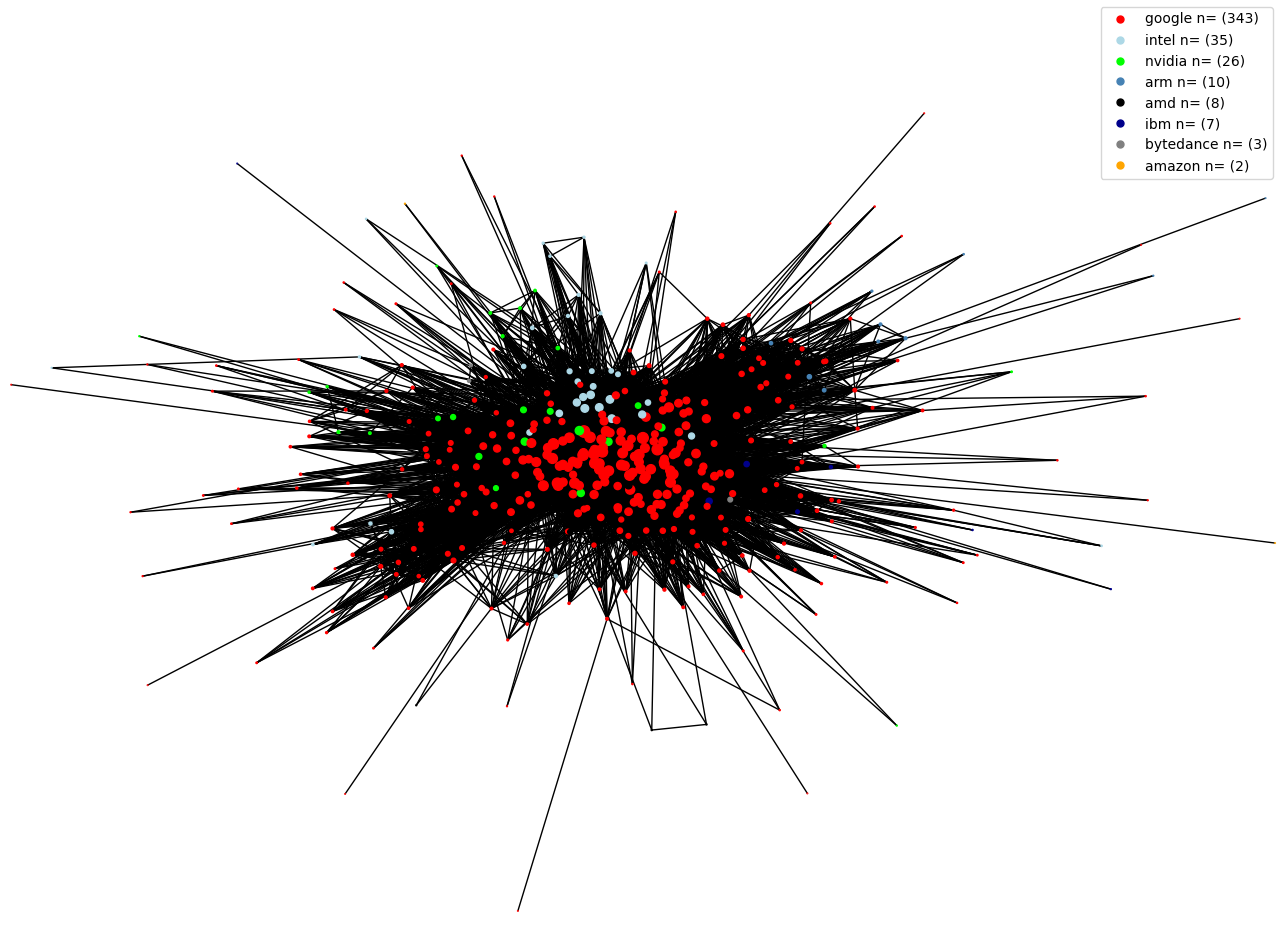
Centrality layout. Nodes coloured by organizational affiliation and sized by centrality.
Nodes position by Fruchterman-Reingold force-directed algorithm.
Bots were filtered and developers names were consolidated.
Limited to the top 10 contributors that compete with others in the co-production of TensorFLow.
All dev. affiliated with ['google','microsoft','ibm','amazon','intel','amd','nvidia','arm','meta','bytedance'].
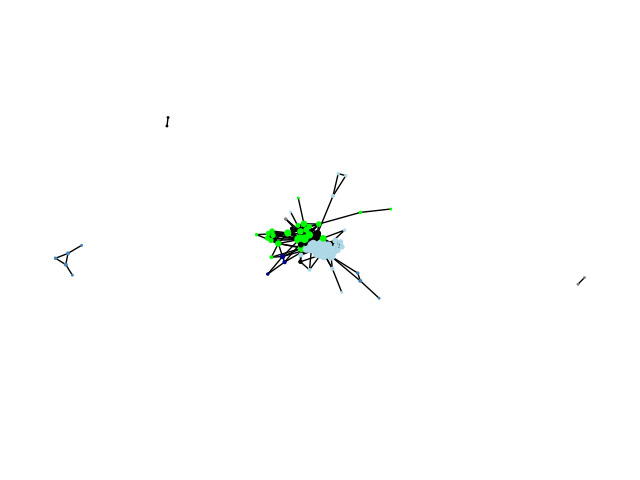
Centrality layout. Nodes coloured by organizational affiliation and sized by centrality.
Nodes position by Fruchterman-Reingold force-directed algorithm.
Bots were filtered and developers names were consolidated.
Limited to the top 10 contributors that compete with others in the co-production of TensorFLow excluding Google.
All dev. affiliated with ['microsoft','ibm','amazon','intel','amd','nvidia','arm','meta','bytedance'].
2020

Circular layout. Nodes coloured by organizational affiliation.
Bots were filtered but developers names were not consolidated yet.
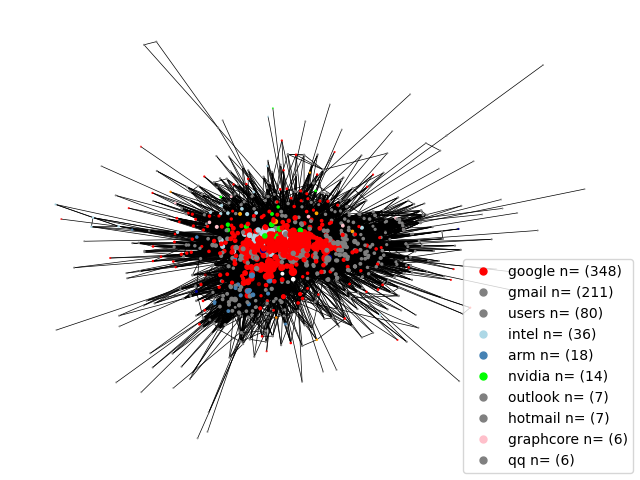
Centrality layout. Nodes coloured by organizational affiliation and sized by centrality.
Nodes position by Fruchterman-Reingold force-directed algorithm.
Bots were filtered but developers names were not consolidated yet.
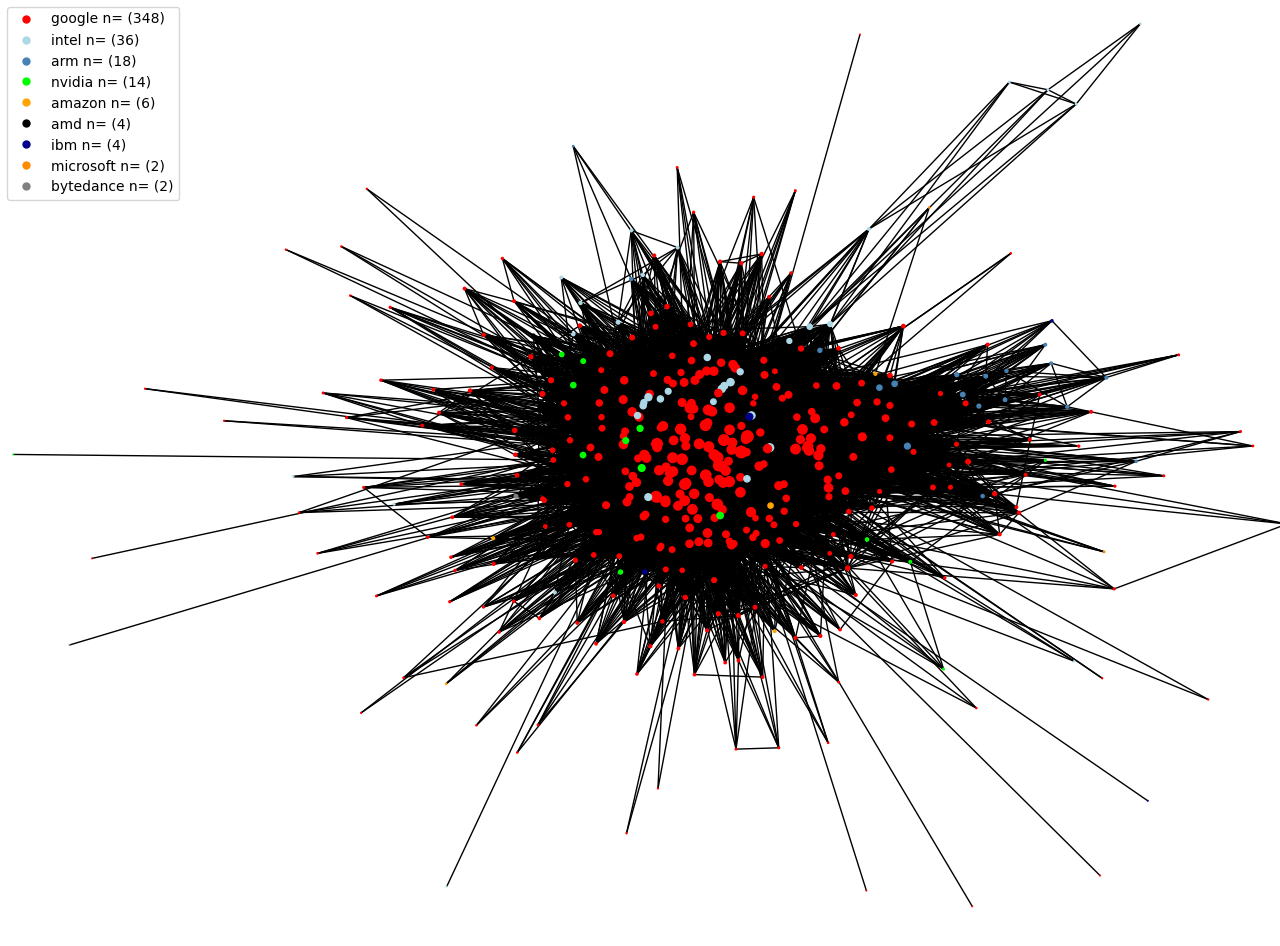
Centrality layout. Nodes coloured by organizational affiliation and sized by centrality.
Nodes position by Fruchterman-Reingold force-directed algorithm.
Bots were filtered and developers names were consolidated.
Limited to the top 10 contributors that compete with others in the co-production of TensorFLow.
All dev. affiliated with ['google','microsoft','ibm','amazon','intel','amd','nvidia','arm','meta','bytedance'].
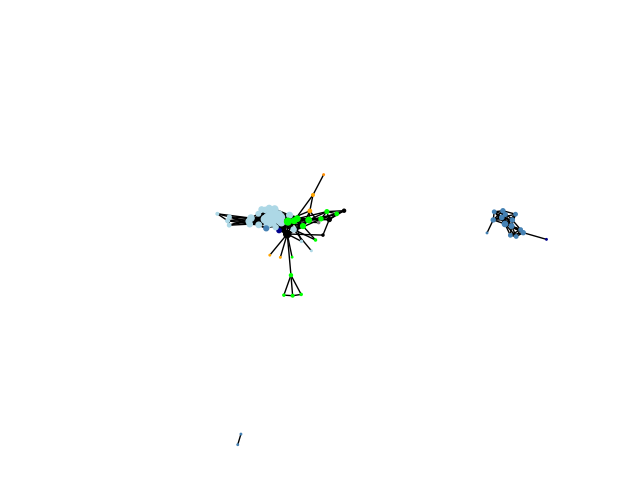
Centrality layout. Nodes coloured by organizational affiliation and sized by centrality.
Nodes position by Fruchterman-Reingold force-directed algorithm.
Bots were filtered and developers names were consolidated.
Limited to the top 10 contributors that compete with others in the co-production of TensorFLow excluding Google.
All dev. affiliated with ['microsoft','ibm','amazon','intel','amd','nvidia','arm','meta','bytedance'].
2021
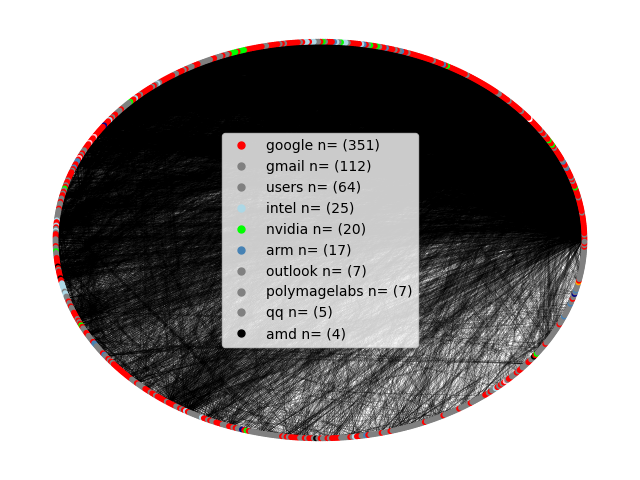
Circular layout. Nodes coloured by organizational affiliation.
Bots were filtered but developers names were not consolidated yet.
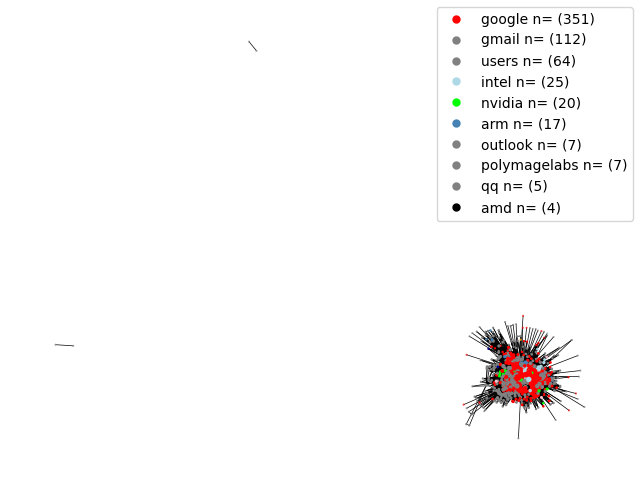
Centrality layout. Nodes coloured by organizational affiliation and sized by centrality.
Nodes position by Fruchterman-Reingold force-directed algorithm.
Bots were filtered but developers names were not consolidated yet.
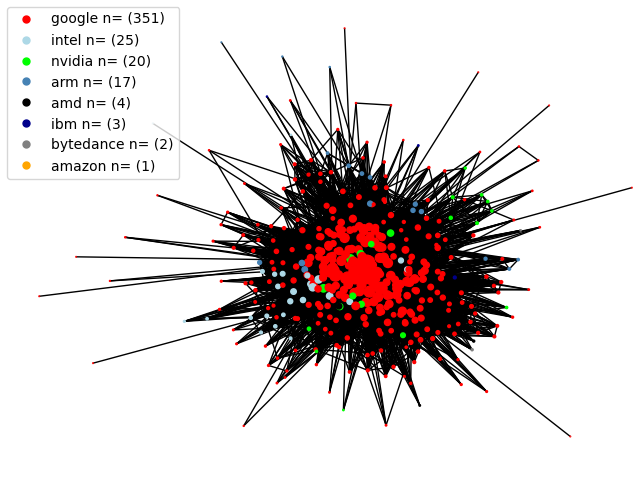
Centrality layout. Nodes coloured by organizational affiliation and sized by centrality.
Nodes position by Fruchterman-Reingold force-directed algorithm.
Bots were filtered and developers names were consolidated.
Limited to the top 10 contributors that compete with others in the co-production of TensorFLow.
All dev. affiliated with ['google','microsoft','ibm','amazon','intel','amd','nvidia','arm','meta','bytedance'].
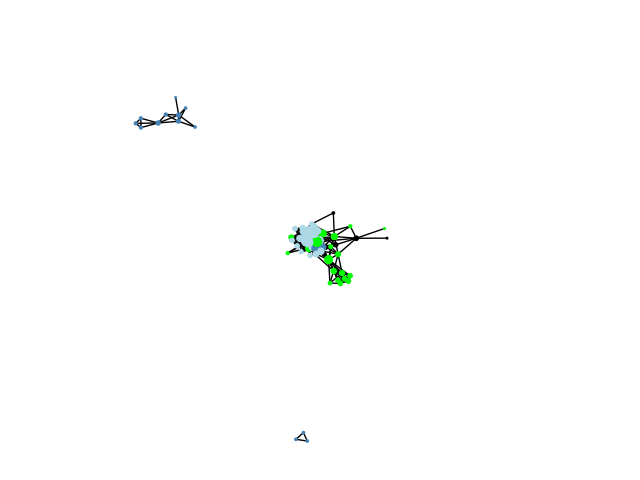
Centrality layout. Nodes coloured by organizational affiliation and sized by centrality.
Nodes position by Fruchterman-Reingold force-directed algorithm.
Bots were filtered and developers names were consolidated.
Limited to the top 10 contributors that compete with others in the co-production of TensorFLow excluding Google.
All dev. affiliated with ['microsoft','ibm','amazon','intel','amd','nvidia','arm','meta','bytedance'].
2022
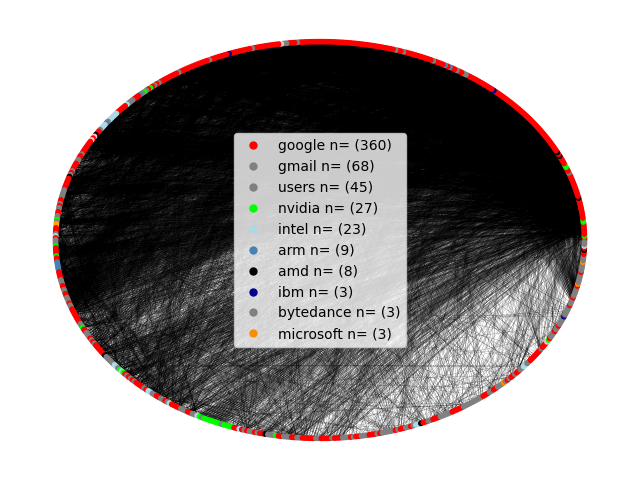
Circular layout. Nodes coloured by organizational affiliation.
Bots were filtered but developers names were not consolidated yet.
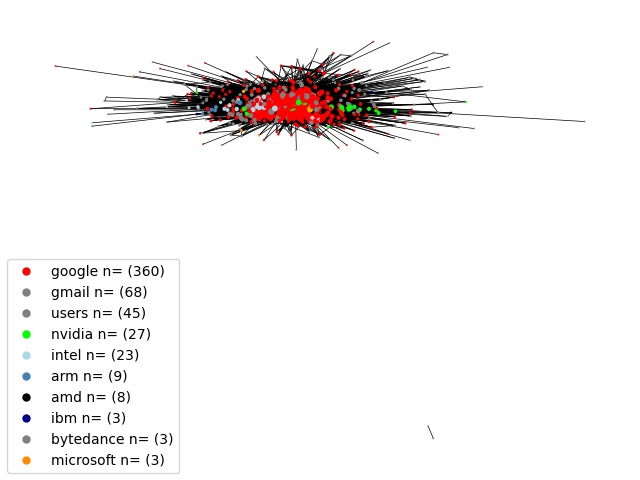
Centrality layout. Nodes coloured by organizational affiliation and sized by centrality.
Nodes position by Fruchterman-Reingold force-directed algorithm.
Bots were filtered but developers names were not consolidated yet.
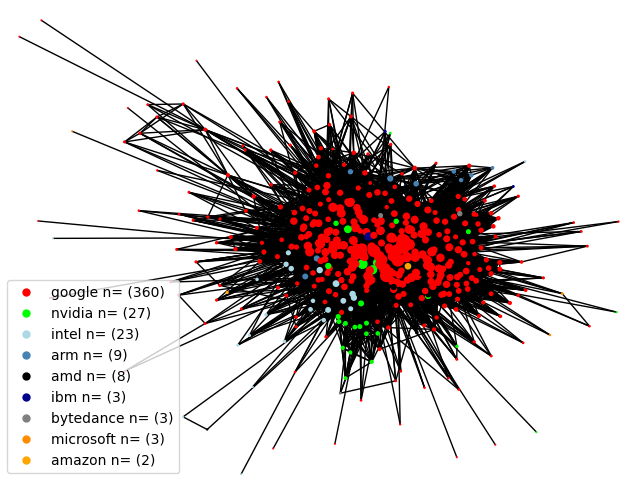
Centrality layout. Nodes coloured by organizational affiliation and sized by centrality.
Nodes position by Fruchterman-Reingold force-directed algorithm.
Bots were filtered and developers names were consolidated.
Limited to the top 10 contributors that compete with others in the co-production of TensorFLow.
All dev. affiliated with ['google','microsoft','ibm','amazon','intel','amd','nvidia','arm','meta','bytedance'].
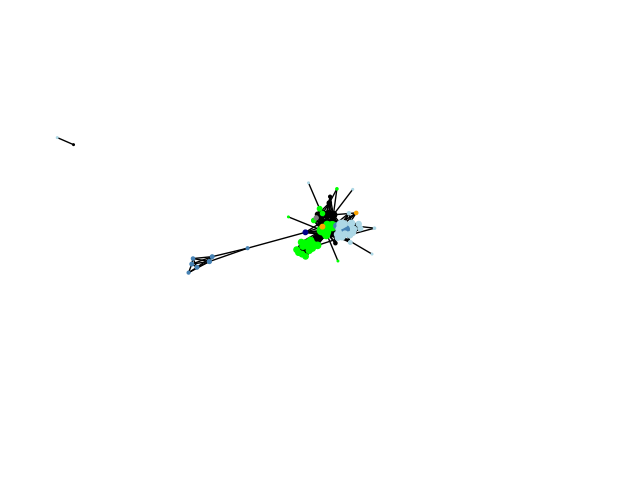
Centrality layout. Nodes coloured by organizational affiliation and sized by centrality.
Nodes position by Fruchterman-Reingold force-directed algorithm.
Bots were filtered and developers names were consolidated.
Limited to the top 10 contributors that compete with others in the co-production of TensorFLow excluding Google.
All dev. affiliated with ['microsoft','ibm','amazon','intel','amd','nvidia','arm','meta','bytedance'].
2023
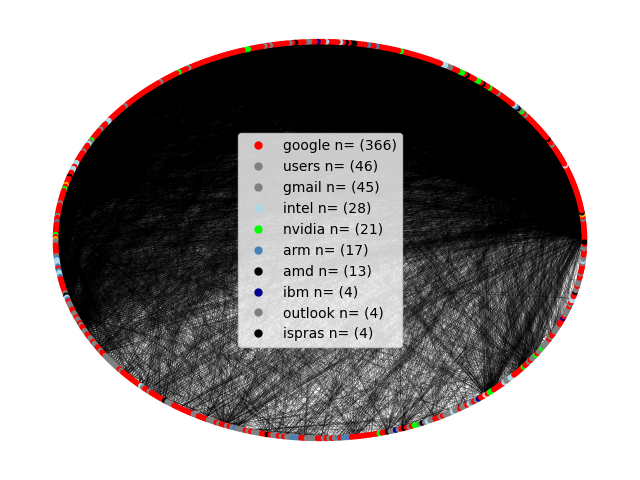
Circular layout. Nodes coloured by organizational affiliation.
Bots were filtered but developers names were not consolidated yet.
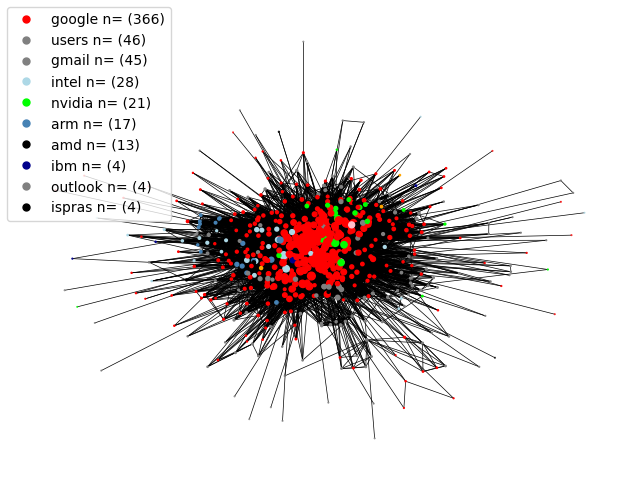
Centrality layout. Nodes coloured by organizational affiliation and sized by centrality.
Nodes position by Fruchterman-Reingold force-directed algorithm.
Bots were filtered but developers names were not consolidated yet.
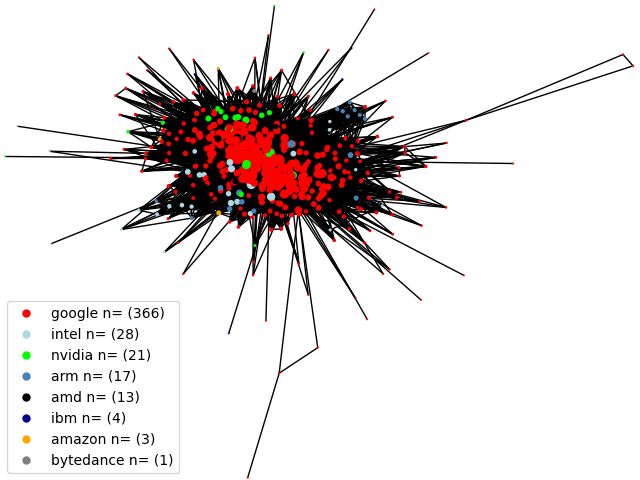
Centrality layout. Nodes coloured by organizational affiliation and sized by centrality.
Nodes position by Fruchterman-Reingold force-directed algorithm.
Bots were filtered and developers names were consolidated.
Limited to the top 10 contributors that compete with others in the co-production of TensorFLow.
All dev. affiliated with ['google','microsoft','ibm','amazon','intel','amd','nvidia','arm','meta','bytedance'].
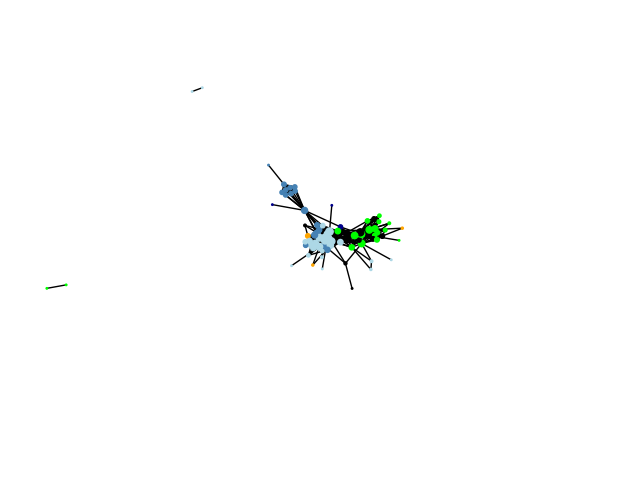
Nodes position by Fruchterman-Reingold force-directed algorithm.
Bots were filtered and developers names were consolidated.
Limited to the top 10 contributors that compete with others in the co-production of TensorFLow excluding Google.
All dev. affiliated with ['microsoft','ibm','amazon','intel','amd','nvidia','arm','meta','bytedance'].
Last months 2024
Circular layout. Nodes coloured by organizational affiliation.
Bots were filtered but developers names were not consolidated yet.
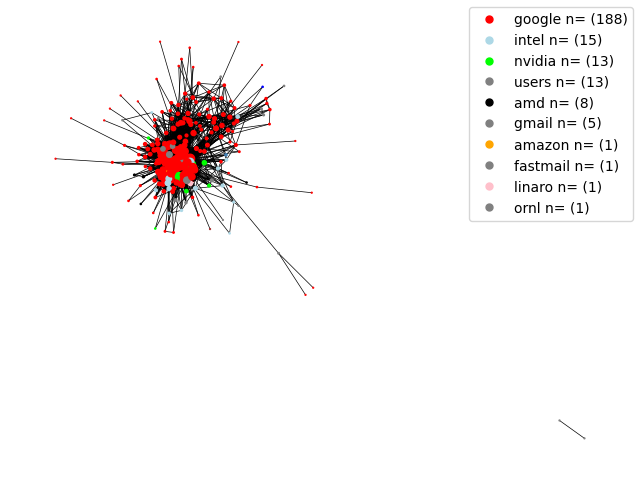
Centrality layout. Nodes coloured by organizational affiliation and sized by centrality.
Nodes position by Fruchterman-Reingold force-directed algorithm.
Bots were filtered but developers names were not consolidated yet.
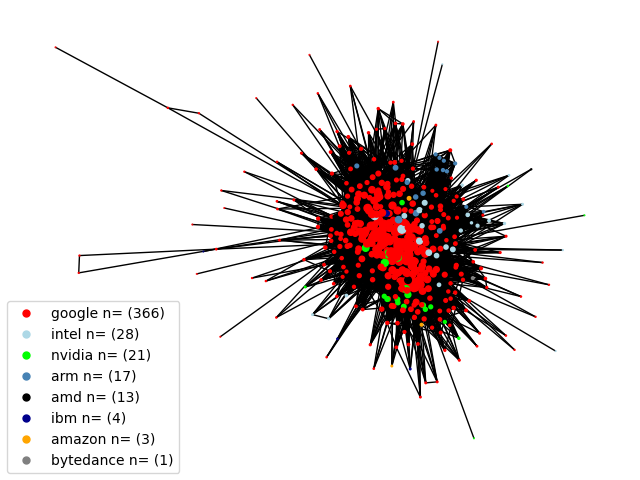
Centrality layout. Nodes coloured by organizational affiliation and sized by centrality.
Nodes position by Fruchterman-Reingold force-directed algorithm.
Bots were filtered and developers names were consolidated.
Limited to the top 10 contributors that compete with others in the co-production of TensorFLow.
All dev. affiliated with ['google','microsoft','ibm','amazon','intel','amd','nvidia','arm','meta','bytedance'].
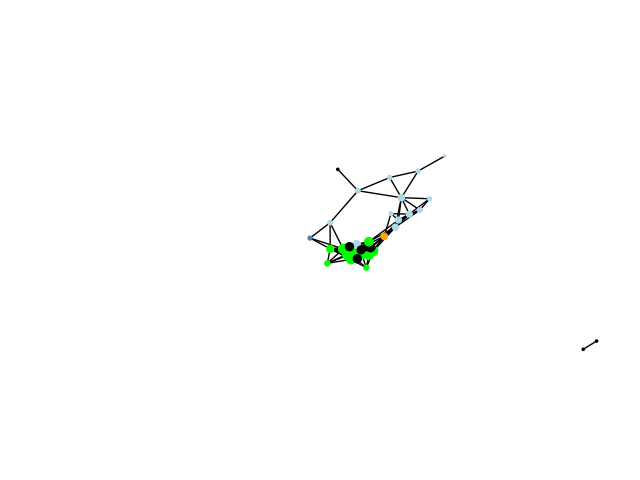
Nodes position by Fruchterman-Reingold force-directed algorithm.
Bots were filtered and developers names were consolidated.
Limited to the top 10 contributors that compete with others in the co-production of TensorFLow excluding Google.
All dev. affiliated with ['microsoft','ibm','amazon','intel','amd','nvidia','arm','meta','bytedance'].
Inter-organizational collaborative networks
Exploring the collaborative networks of non-commercial organizations (7 Nov 2013 - 12 April 2024)
- Seoul National University - SNU (Korean: 서울대학교)
- German Research Center for Artificial Intelligence (German: Deutsches
Forschungszentrum für Künstliche Intelligenz - DFKI)
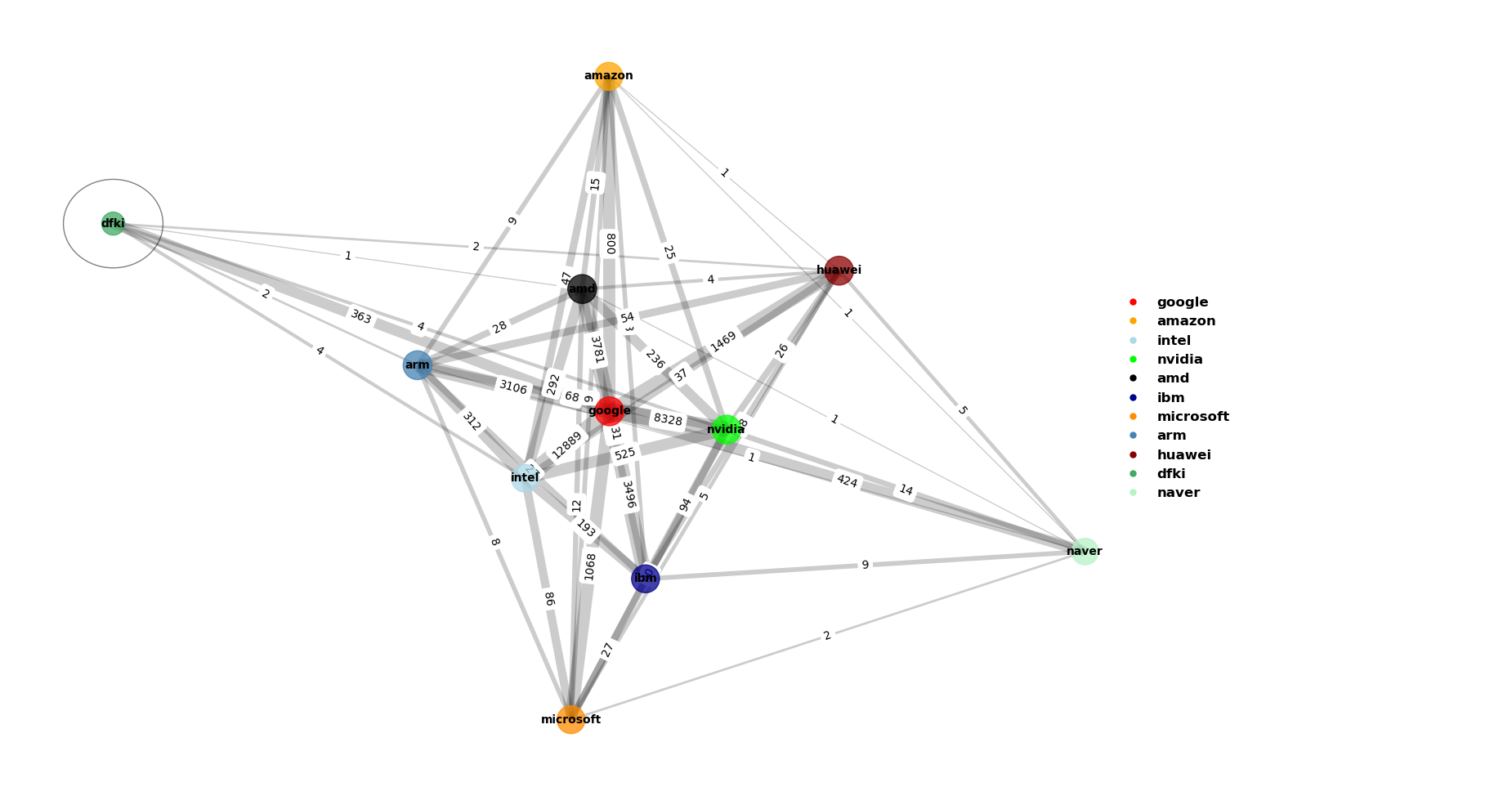
dfki.png - Nodes are organizations, edges are collaborative relationships, edges-weights are unique pairs of developers into a dyadic inter-organizational relationship (i.e., intensity of collaboration). - Chromium - a free and open-source web browser project
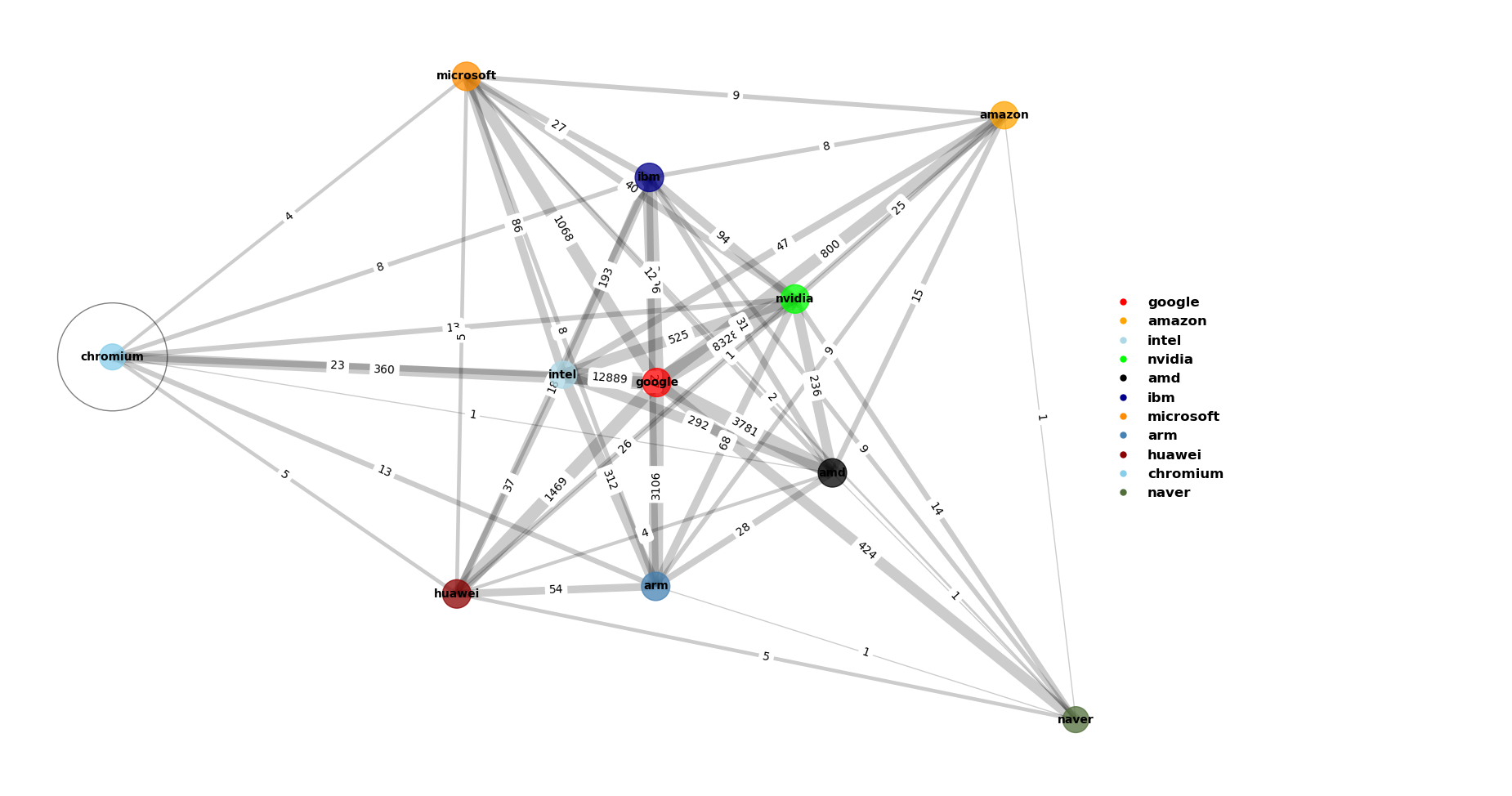
chromium.png - Nodes are organizations, edges are collaborative relationships, edges-weights are unique pairs of developers into a dyadic inter-organizational relationship (i.e., intensity of collaboration). - Institute for System Programming - ISP of the Russian Academy of Sciences
(Russian: Институт системного программирования)
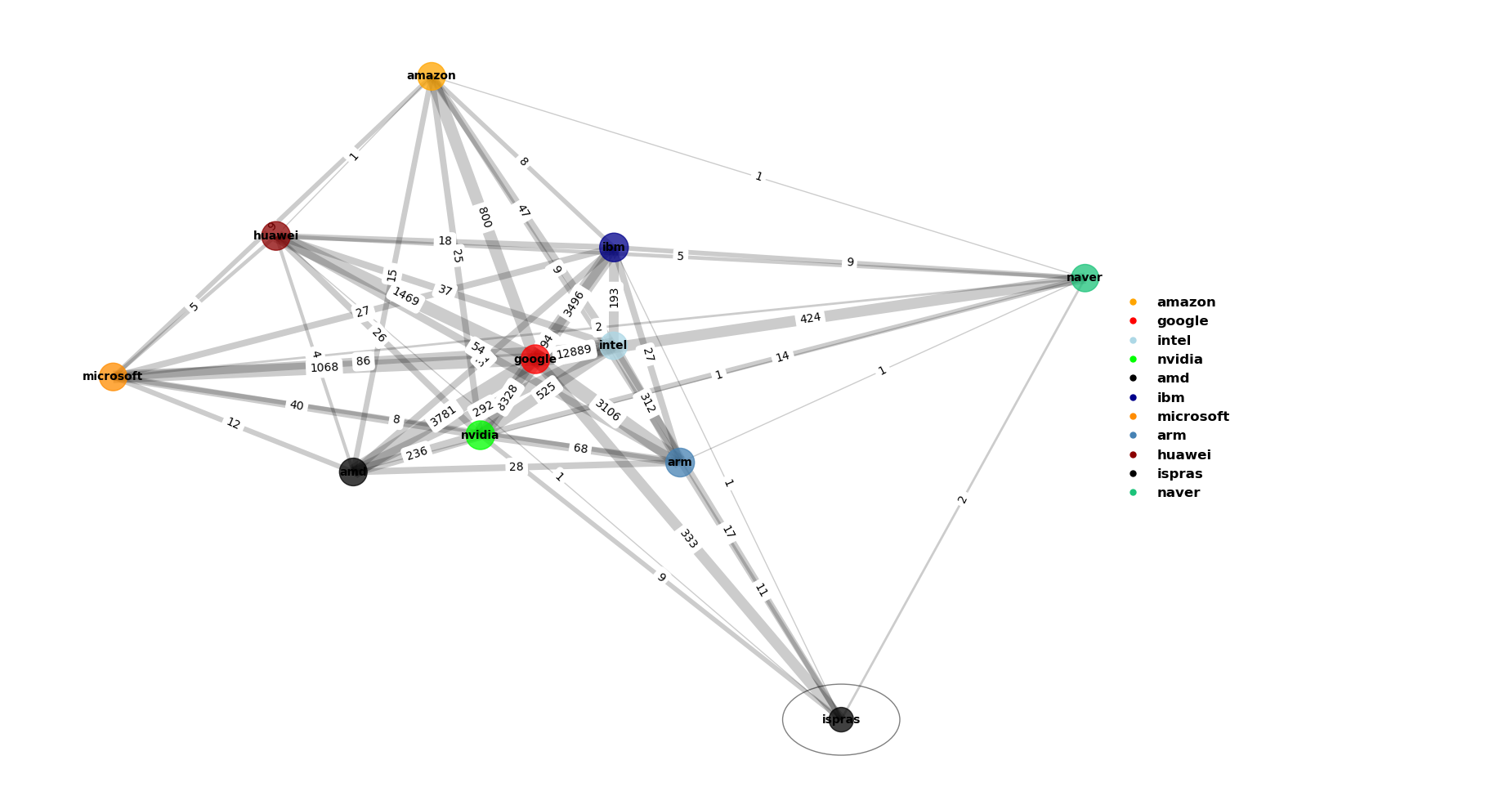
ispras.png - Nodes are organizations, edges are collaborative relationships, edges-weights are unique pairs of developers into a dyadic inter-organizational relationship (i.e., intensity of collaboration). - Peking University - PKU (Simplified Chinese :北京大学)
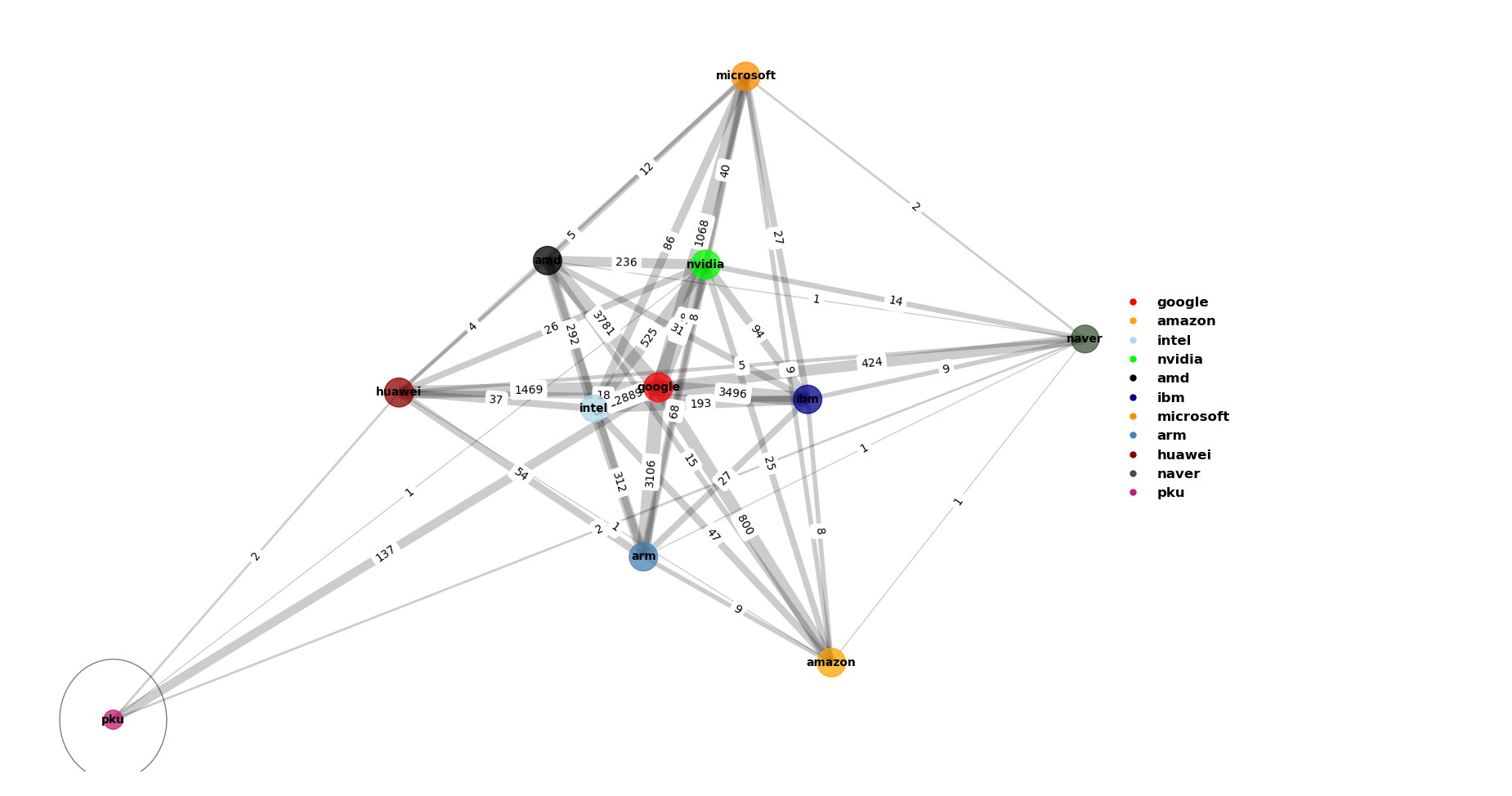
pku.png - Nodes are organizations, edges are collaborative relationships, edges-weights are unique pairs of developers into a dyadic inter-organizational relationship (i.e., intensity of collaboration). - Georgia Institute of Technology - GeorgiaTech
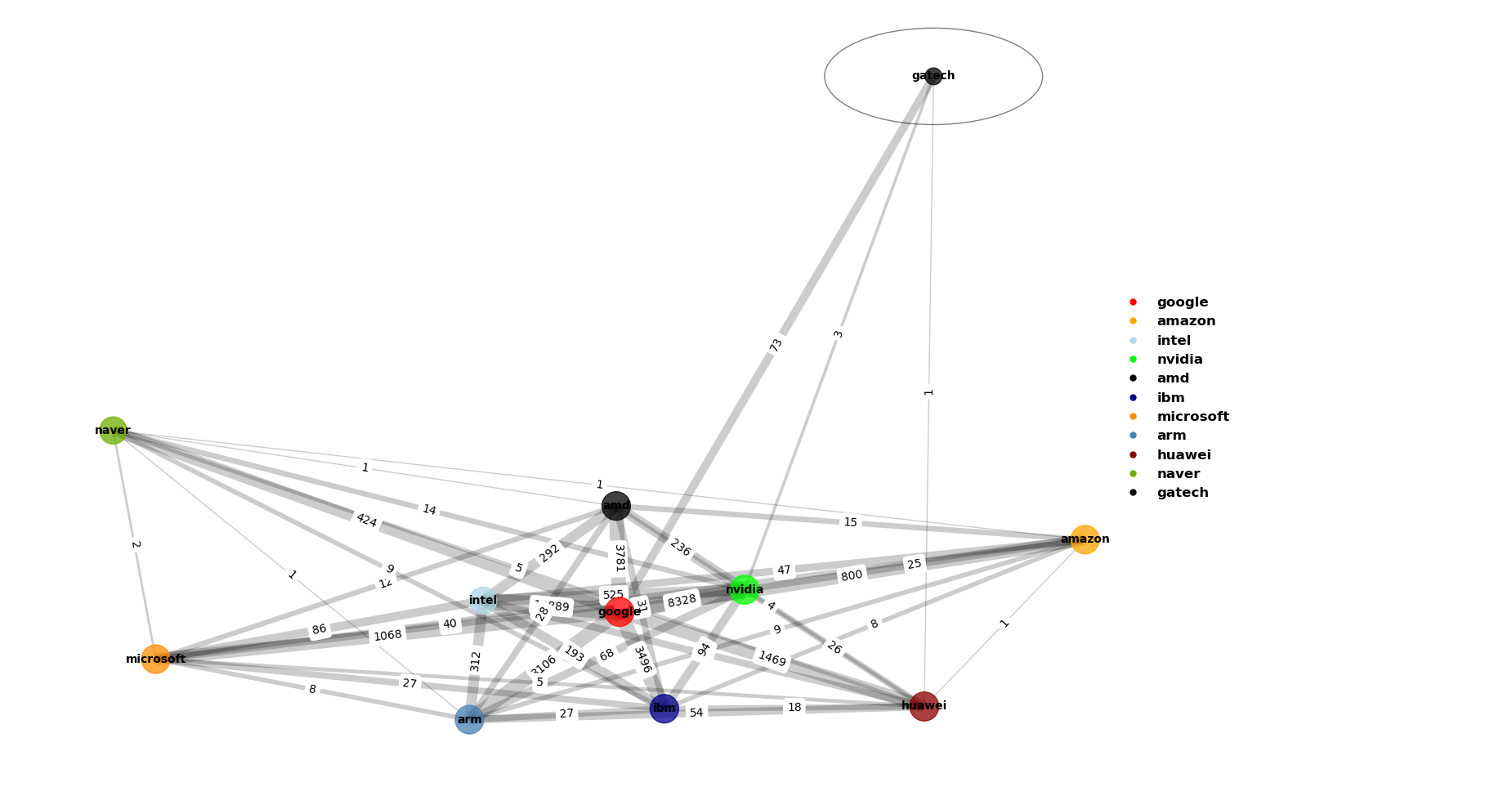
gatech.png - Nodes are organizations, edges are collaborative relationships, edges-weights are unique pairs of developers into a dyadic inter-organizational relationship (i.e., intensity of collaboration). - Massachusetts Institute of Technology - MIT
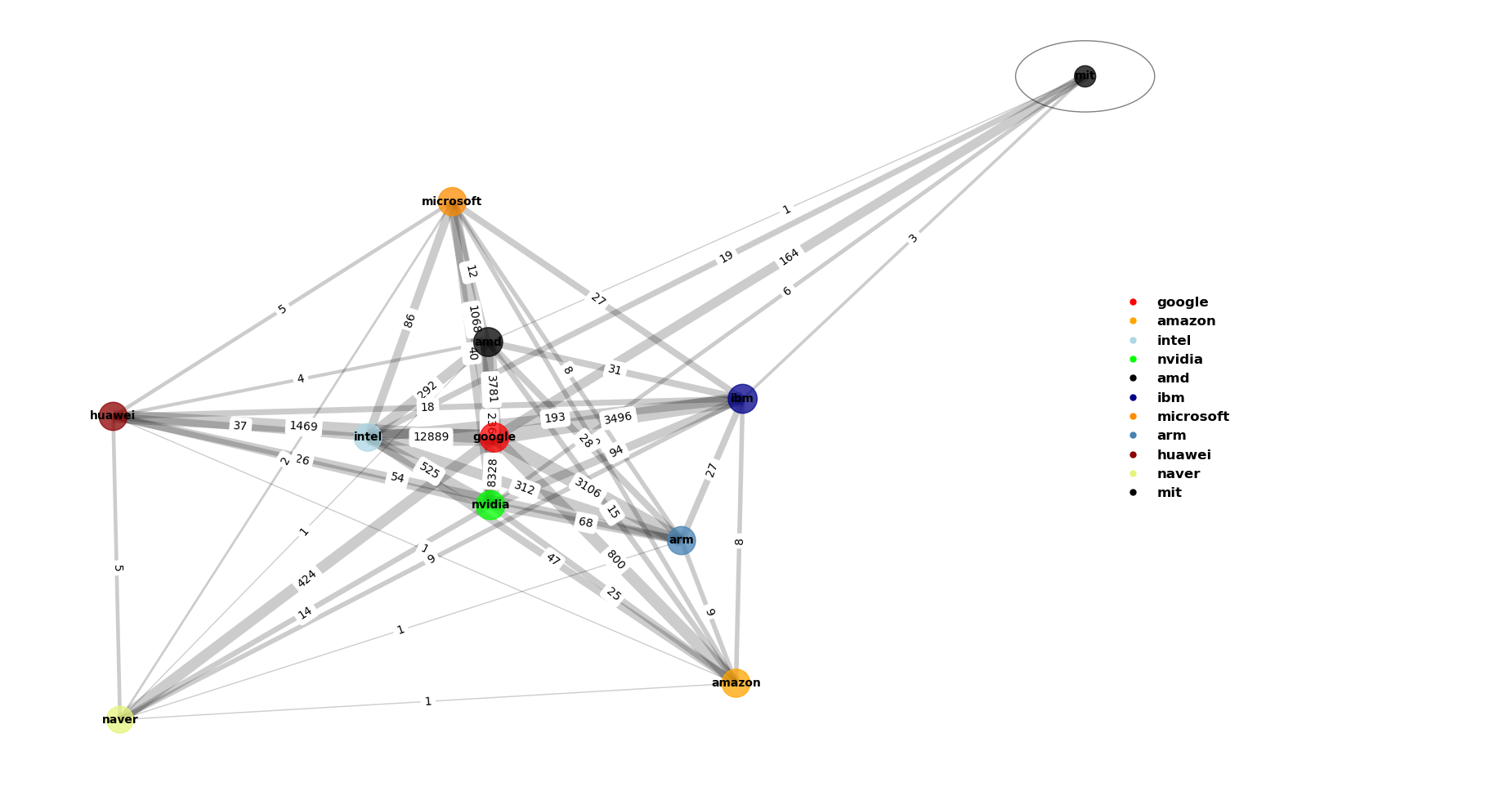
mit.png - Nodes are organizations, edges are collaborative relationships, edges-weights are unique pairs of developers into a dyadic inter-organizational relationship (i.e., intensity of collaboration). - Apache Software Foundation - an American nonprofit corporation to support a
number of open-source software projects
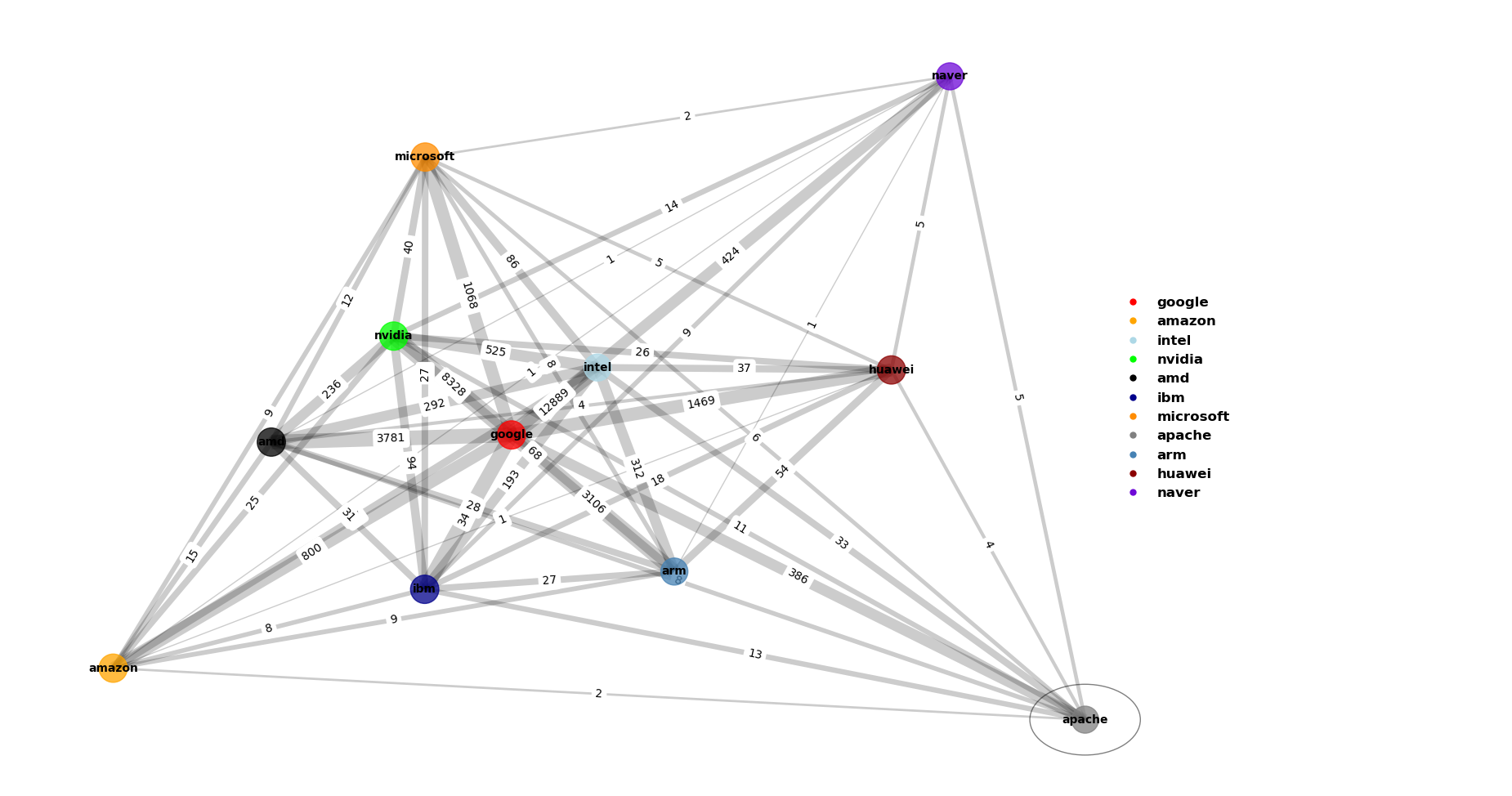
apache.png - Nodes are organizations, edges are collaborative relationships, edges-weights are unique pairs of developers into a dyadic inter-organizational relationship (i.e., intensity of collaboration). - Royal Institute of Technology (Swedish: Kungliga Tekniska högskolan - KTH)
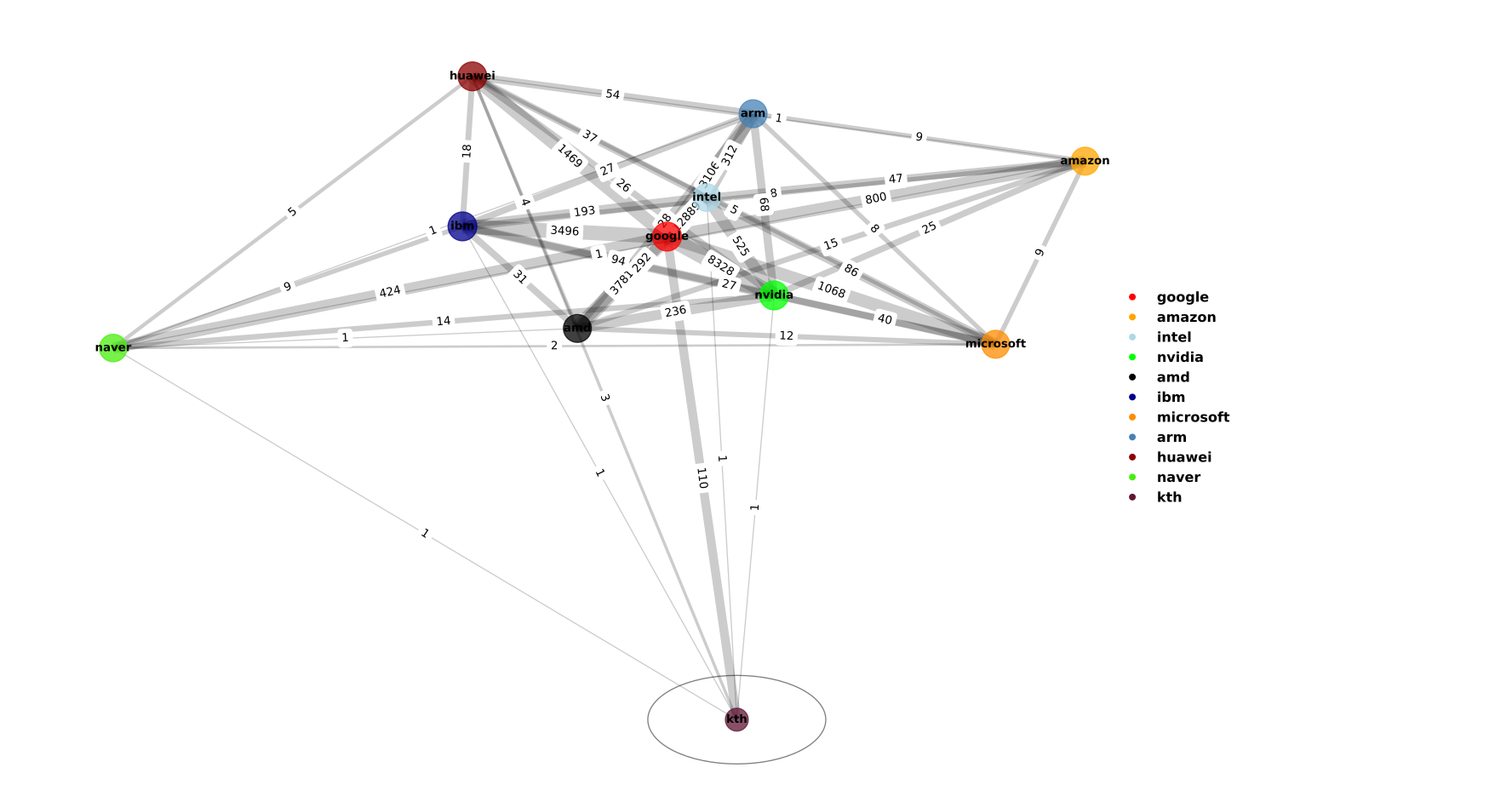
kth.png - Nodes are organizations, edges are collaborative relationships, edges-weights are unique pairs of developers into a dyadic inter-organizational relationship (i.e., intensity of collaboration). - University of California, Berkeley
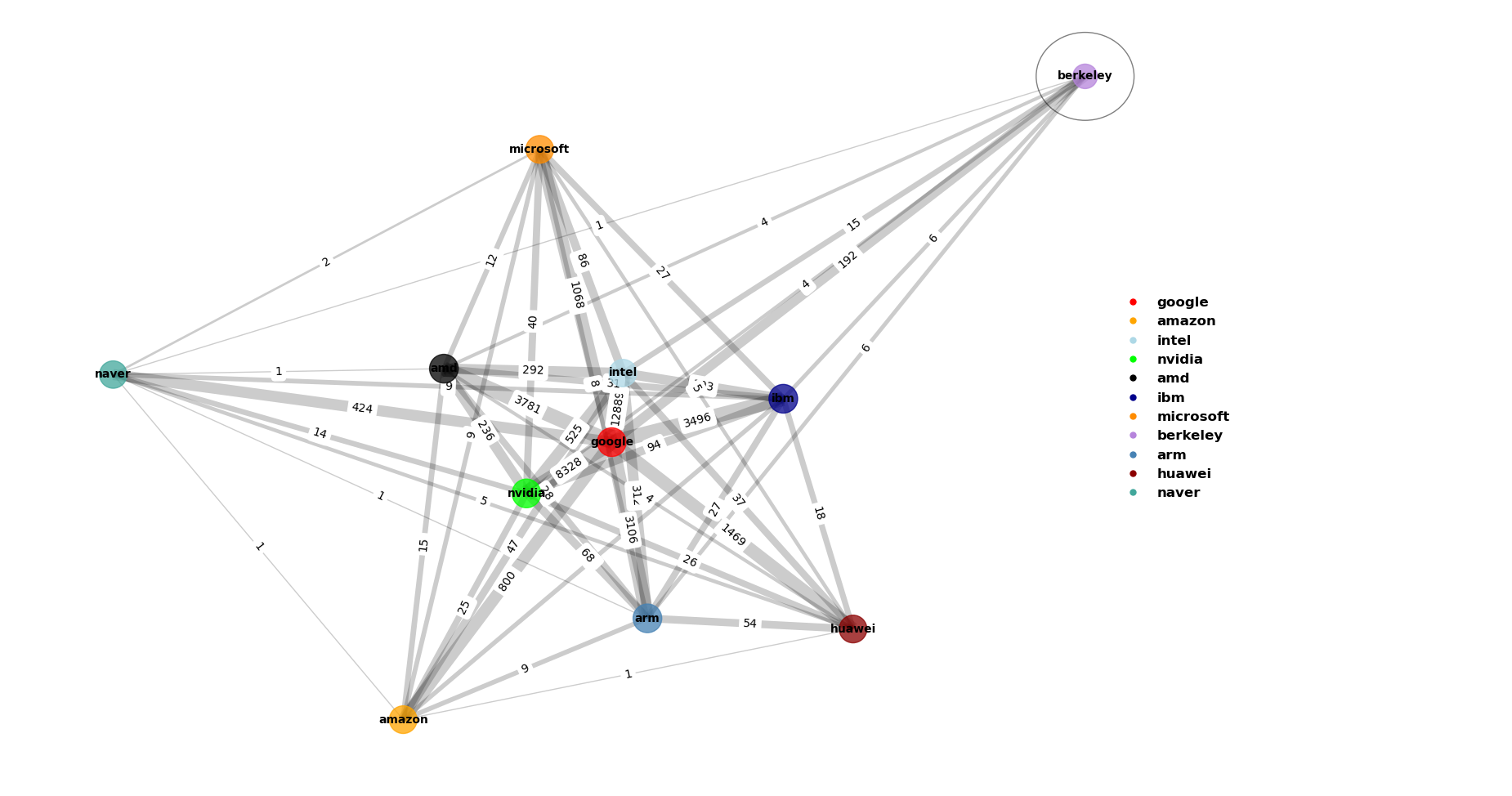
berkeley.png - Nodes are organizations, edges are collaborative relationships, edges-weights are unique pairs of developers into a dyadic inter-organizational relationship (i.e., intensity of collaboration).
Expected contributions
Expected theoretical contributions
Preliminary answers to the guiding research questions:
- Why do tech giants like Google open-source advanced and complex technological platforms that started in-house?
- Extended R&D reach;
- Extending the size of the market;
- Creating demand for complementary products and services (e.g., computing services, chip-design, quality labelled data, AI/ML models);
- Finding external complementarities;
- Providing strong arguments for future anti-trust cases;
- Easier cooperation and integration with academia;
- Extended reputation in interactions with academia;
- Easier talent identification and evaluation;
-
Why are different organizations cooperating with competitors in the co-production of
advanced technological platforms?
- In the case of competing chip-makers, like Nvidia, Intel, ARM and AMD, not co-cooperating would mean that TensorFlow loads would run in the chips of competitors.; It is of all chip-makers interest to insure that TensorFLow runs on their chips;
- The same for vendors of hardware enabling AI/ML (e.g., servers or specialized boards);
- The same for vendors of hardware with AI/ML features (e.g., cars and tools with computer vision recognition);
- The same for vendors of hosted computing services;
- Also, by cooperating with competitors, in certain conditions, the size of the market also extends via extended networks reach;
- Avoid the fragmentation of AI/ML frameworks. Standarization
Expected methodological contributions
- The use of Fruchterman-Reingold force-directed algorithm allow the identification of small isolated sub-communities in the TensorFlow community on the fly. Something that was is not captured on visualizations based on degree centrality as in Teixeira et al. (2015) and Teixeira et al.(2016).
- A simple but yet elegant way of combining quantitative, quantitative and relational social network data.
Publications
By chronological order as results got published:
- Teixeira, J. A., Ahmed, S. S., Laine-Kronberg, L., Mezei, J., & Smailhodzic, E. (2025). Towards understanding open and coopetitive platform ecosystems: The case of TensorFlow. in Proceedings of the 33th European Conference on Information Systems (ECIS 2025) AIS (conditionally accepted 28 Feb 2025). Open-access right here.
Links
Related master thesis projects
Wikipedia pages on open-source and open-coopetition
Past related projects
- Social Network Analysis of the OpenStack cloud computing software ecosystem By Jose Teixeira and partners
- Social Network Analysis of the WebKit web-browsing engine software ecosystem By Jose Teixeira and partners
Blogs and articles on the history of TensorFlow
- Everything You Wanted To Know About TensorFlow by databriks
- A Brief History of Deep Learning Frameworks by Lin Yuan in Towards Data Science.
- Towards ML Engineering: A Brief History Of TensorFlow Extended (TFX), posted by Konstantinos (Gus) Katsiapis on behalf of the TFX Team
Blogs on the TensorFlow way of working
- Tensorflow Committers By Augustina Ragwitz
- How the TensorFlow team handles open source support – O’Reilly article by Pete Warden
Blogs on why TensorFlow is open-source
- TensorFlow Is Open-Source, But Why?A peek into Google’s open-source strategy. By Haifeng Jin - Nov 1, 2022 in Towards Data Science.
- Six reasons why Google open sourced TensorFlow . By Kunal Parikh - Sep 13, 2017 in packtpub hub.
- Economic Value of Learning and Why Google Open Sourced TensorFlow. By Bill Schmarzo - Feb, 2019 in Data Science Central.
- Why did Google open-source Tensor Flow - Whats in it for them?. Quora thread.
Blogs on why TensorFlow is coopetitive
- Any?
Videos on what is TensorFlow
- The Road Ahead: Google's Comprehensive Platform for Open Source Machine Learning. From YouTube tensorFlow channel.
Videos on the history of TensorFlow
- PyTorch vs TensorFlow | Ishan Misra and Lex Fridman
- François Chollet: History of Keras and TensorFlow | AI Podcast Clips
Videos on why TensorFlow is open-source
- TensorFlow: Open source machine learning . On Google YouTube channel Nov 9, 2015.
- Fox news Tech Take episode interview with Eric Yaverbaum . On FOX News Videos and Yahoo!finance Nov 13, 2015.
Videos on TensorFlow way of working
Tutorials for master students and doctoral students joining the project
- "Matplotlib Legend Tutorial || matplotlib legend outside of graph || Matplotlib Tips" on YouTube.
- "Control Matplotlib figure size using figsize option in python" on YouTube.
- "Full Git Tutorial (Part 7) - Git Log Fully Explained" on YouTube.
Videos on theory for master students and doctoral students joining the project
On the triple-helix innovation model
- "Henry Etzkowitz: "Innovation in Innovation: Moving Beyond Boundaries to Triple Helix Hybrid Spaces on YouTube.
- Michiel Sweers on the “Triple Helix” Innovation Model │ Mission Imagination on YouTube.
- The Quadruple Helix and Power to the People | Jorge Garcia | TEDxABQSalon on YouTube.
- Quadruple/Quintuple Helix Innovation by Elias Carayannis - George Washington University On YouTube.
On open-innovation
On open source software
- Open Source Explained by IBM on YouTube.
- Watch "The Promise of Open Source Semiconductor Design Tools" on YouTube.
On coopetition
On open-coopetition
Websites on theory for master students and doctoral students joining the project
Contact
Jose Teixeira < jose.apolinarioteixeira AT aalto.fi >